

Reclaimed Antique Terracotta Flooring and Its Second Life | De Ferranti
For Architects, Interior Designers and Project Teams
At De Ferranti, so much of what we do has you in mind. We know professional readers need more than attractive editorial. You need well-researched material insight that can support specification, spark design ideas, and add value to your CPD record. So we have done the research for you and turned that knowledge into something clear, useful and easy to apply.
To make that value immediate, we have also included two CPD-friendly templates at the end of the article: one for architects and one for interior designers. They are designed to help you log the learning quickly and with minimal effort.
We see architects, interior designers and project teams as important long-term partners and collaborators in the way we work, think and create.
Estimated Reading Time: 18-20 minutes
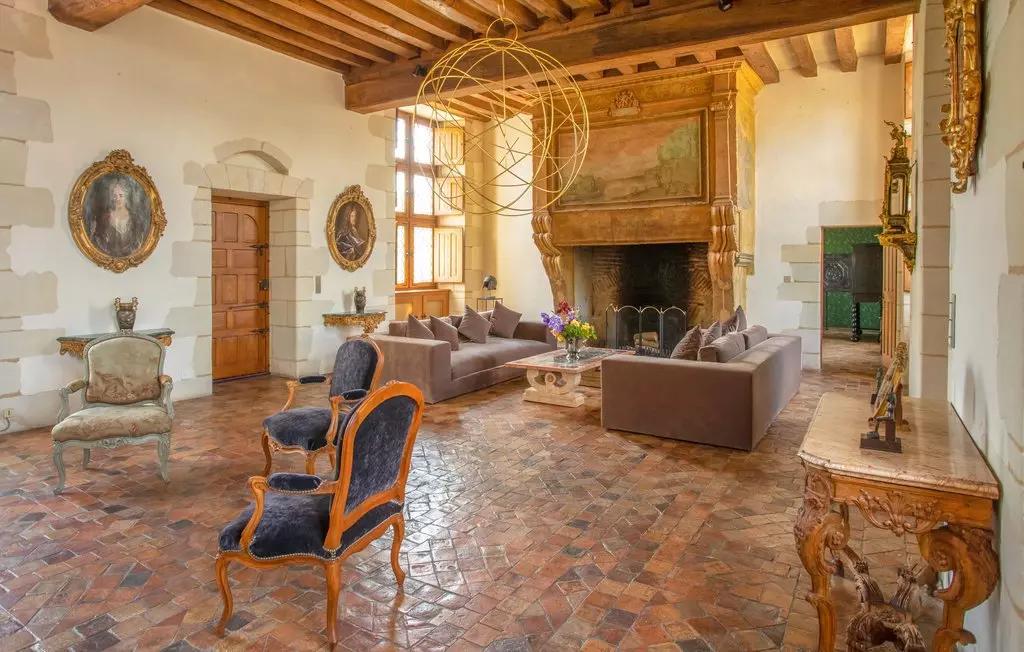
For generations, a terracotta tile may have lain beneath the feet of those who lived and worked in a farmhouse, country house or village dwelling. Countless footsteps have polished its surface, softened its edges and left their traces upon the clay. Its colour reflects the earth from which it was made, the conditions of firing and, sometimes, years of later wear and treatment. When a building is altered or its materials recovered, the tile may be lifted, cleaned and sorted before finding its place in another floor. There it begins a second life, bringing the marks of its original making into a different architectural setting.
Such floors are not confined to one region or one familiar shade of red. De Ferranti’s reclaimed antique terracotta collection brings together French clay tiles, other European reclaimed formats and the red and black pammets of Suffolk. Each has a different relationship with colour, geometry and regional building traditions. The two French products, Blanc Rose Terracotta and Hexagon Antique French Reclaimed Terracotta, sit alongside four products identified more broadly as European and one distinctly English floor.
An architect choosing reclaimed clay begins with the material that exists, not a factory sample that can be reordered indefinitely. Dimensions, condition, colour and usable quantity will depend on the recovered lot. A square field, a run of bricks and a hexagonal floor create quite different rooms; the attraction of age must therefore be balanced with careful setting out and practical specification.
Antique Terracotta and the Art of Artificial Ageing
Genuine reclaimed terracotta has already performed a role within a building before being recovered for another project. By contrast, an aged or distressed tile is newly made and deliberately finished to suggest an older surface. Both may be attractive architectural choices, but they are not interchangeable descriptions. The difference lies in a tile’s history, not simply in how uneven or weathered its surface appears.
With newly manufactured terracotta, skilled craftsmen may soften edges, lightly abrade the face, introduce surface texture or work with washes, oils and tinted waxes. Hand moulding and traditional firing can introduce further irregularity, although these manufacturing methods do not themselves make a tile antique. Carefully applied treatments can imitate some of the subdued colour and apparent wear of an established floor, but they are not the same.
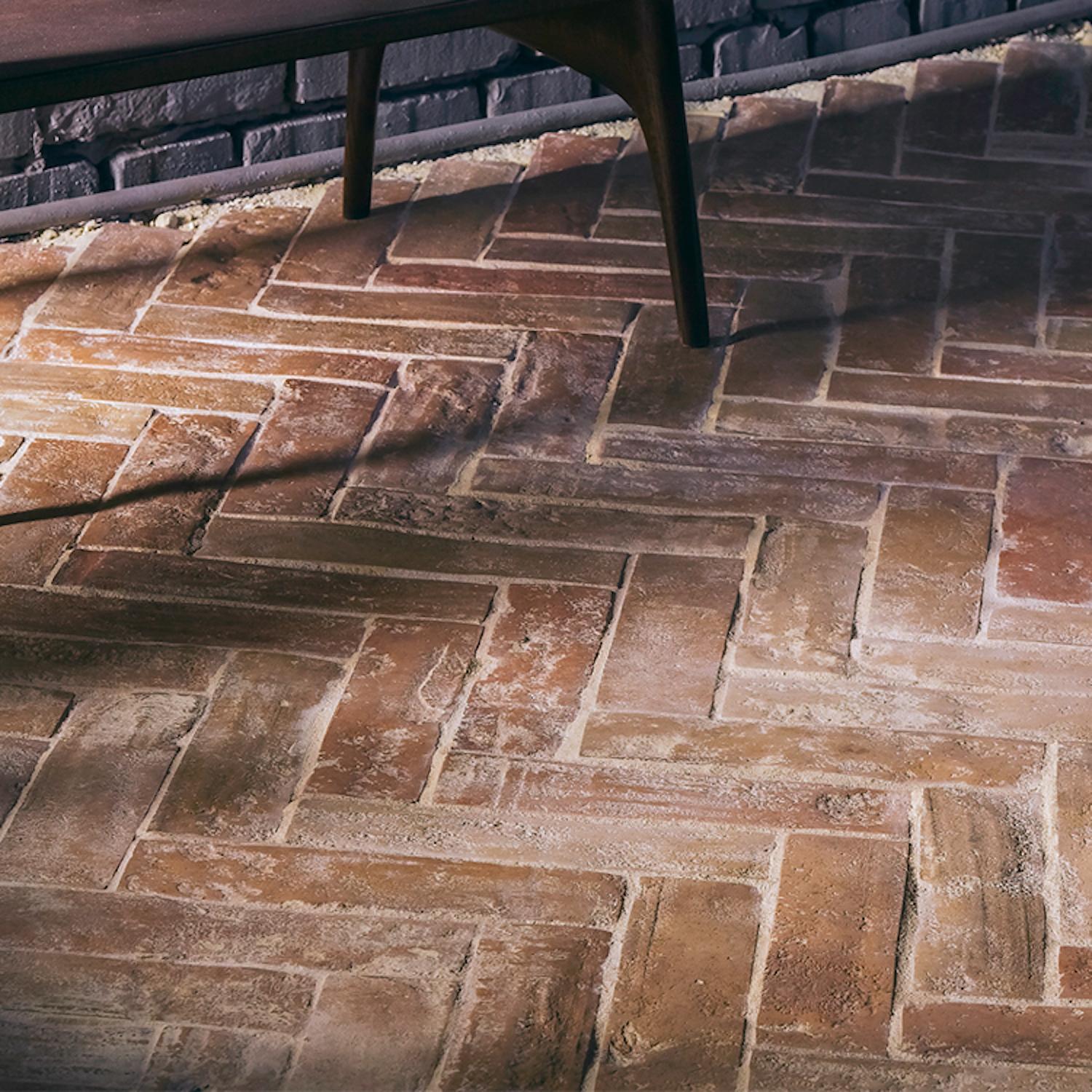
Newly manufactured terracotta with a deliberately aged or distressed appearance.
An original reclaimed terracotta tile may instead show a gently polished face, rubbed corners or small irregularities inherited from its mould. Its colour may travel from cream, biscuit and rose to brick red and brown, or belong to an entirely different local palette. The evidence is cumulative, and always the result of decades or even centuries of use; and it is precisely this wear and tear, or patina, which gives each tile it’s inimitable character.
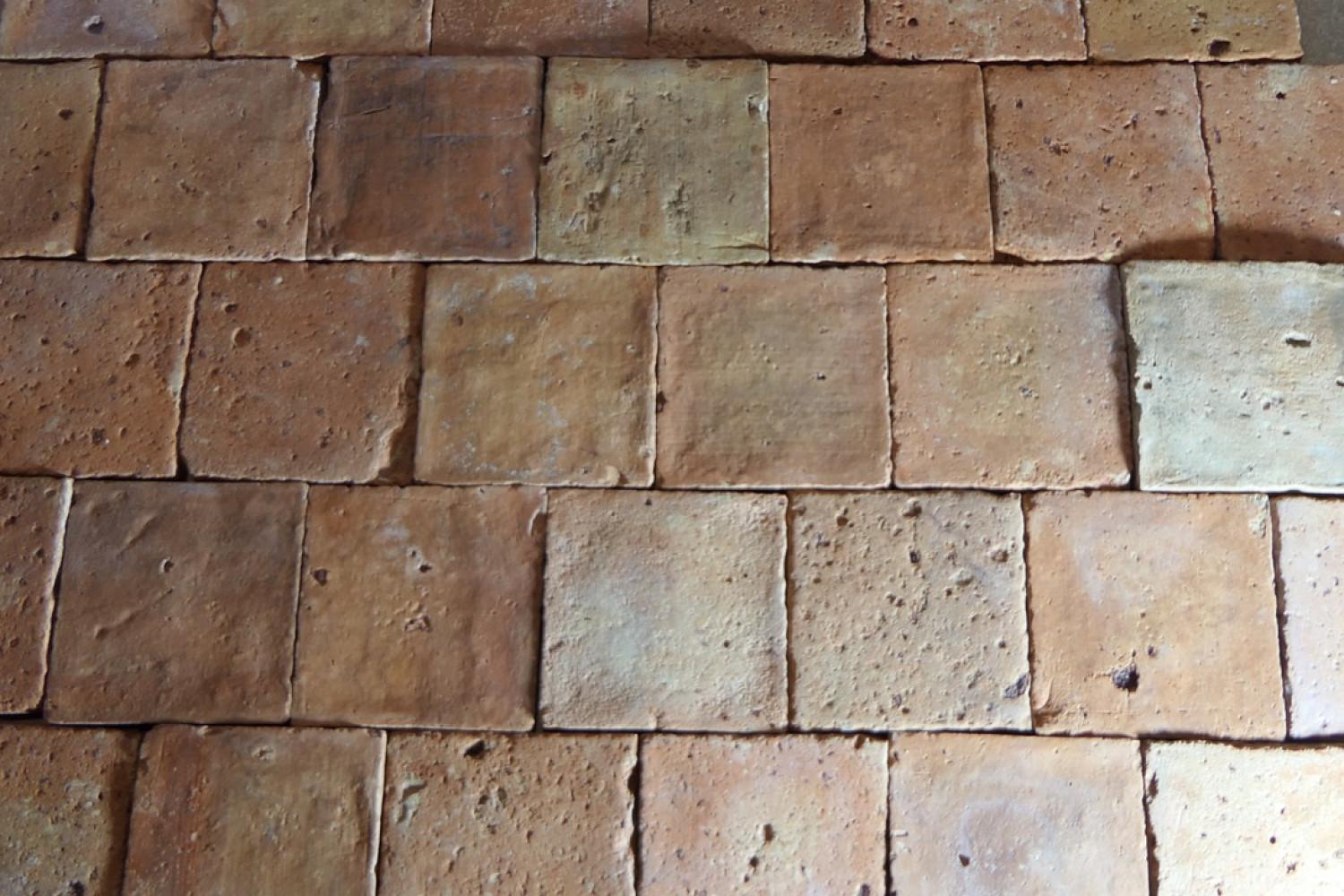
A varied terracotta floor showing softened edges and differing surface textures.
When deciding to work with authentic antique or newly made distressed terracotta, cost can also influence the decision. Distressed terracotta will often be the more economical choice, especially when large quantities are needed, while reclaimed flooring may carry costs associated with recovery, sorting, scarcity and installation. Elaborate handmade reproductions can, however, be as expensive as antique material; therefore, a meaningful comparison considers the complete installed floor, not just a price per square metre.
Clay, Kiln and the Marks of Making
The clay is the beginning of a floor’s colour and texture. Mineral composition, preparation, forming and firing all influence the finished body. Hand moulding may leave surface ripples, slight differences in thickness or impressions that become more apparent when a group of tiles is laid together. Other characteristics belong to the years after manufacture: abrasion, moisture, cleaning, earlier bedding and treatments.
Some reclaimed French tiles were fired in traditional wood-burning kilns, in which temperature and atmosphere were less uniformly controlled than in modern industrial production. One firing could produce lighter and darker pieces, although the colour visible now cannot be assigned to kiln conditions alone. Equally, we should not assume that every product in a collection spanning several European traditions was manufactured in precisely the same way.
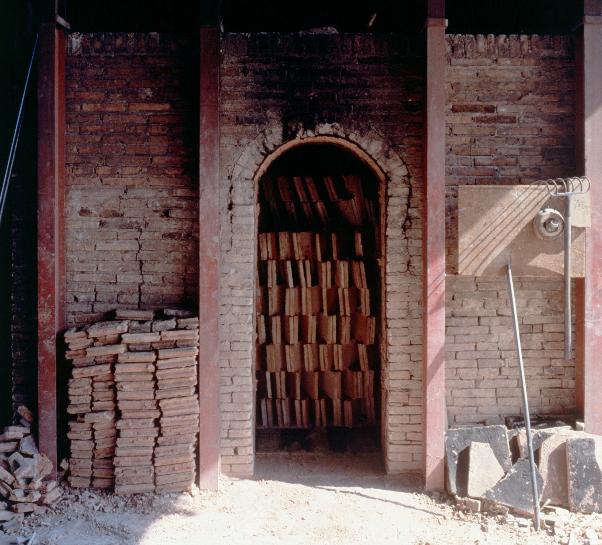
Traditional masonry kiln with clay building units.
The reverse side of a tile bearing traces of an earlier mortar bed, or the different wear of face and edge, may offer clues to its past. Such marks are worth examining, but they should not be turned into a fabricated provenance. Nor should patina be confused with deterioration: a sound, rubbed corner is one thing, while crumbling or powdering surfaces, active salts or deep fractures call for much closer examination.
Tomettes and the French Hexagonal Tradition
In French domestic architecture, the word tomette is particularly associated with relatively small terracotta floor tiles, often hexagonal, although square examples also belong to the tradition. Old kitchens, passages and country houses provide many surviving instances. The familiar six-sided arrangement establishes a continuous geometry, even when individual edges have lost their mechanical regularity through making or wear.
In this context, the scale of each tile changes the effect; where smaller hexagons produce a close-grained field; larger ones give the surface and colour of each tile more prominence. Squares may be laid in straight courses or on the diagonal, while the choice of joint width and colour affects how sharply a pattern is read. These observations describe a French flooring tradition, rather than every antique terracotta product in De Ferranti’s wider collection.
Parefeuille and the Clay Above Our Heads
Not all historic French clay tiles began life underfoot. In parts of southern France, parefeuilles were comparatively thin, flat terracotta tiles used beneath roof coverings and in other forms of traditional construction. Their rectangular proportions suited parts of a building’s less visible fabric, and recovered examples are occasionally offered for new floor installations.
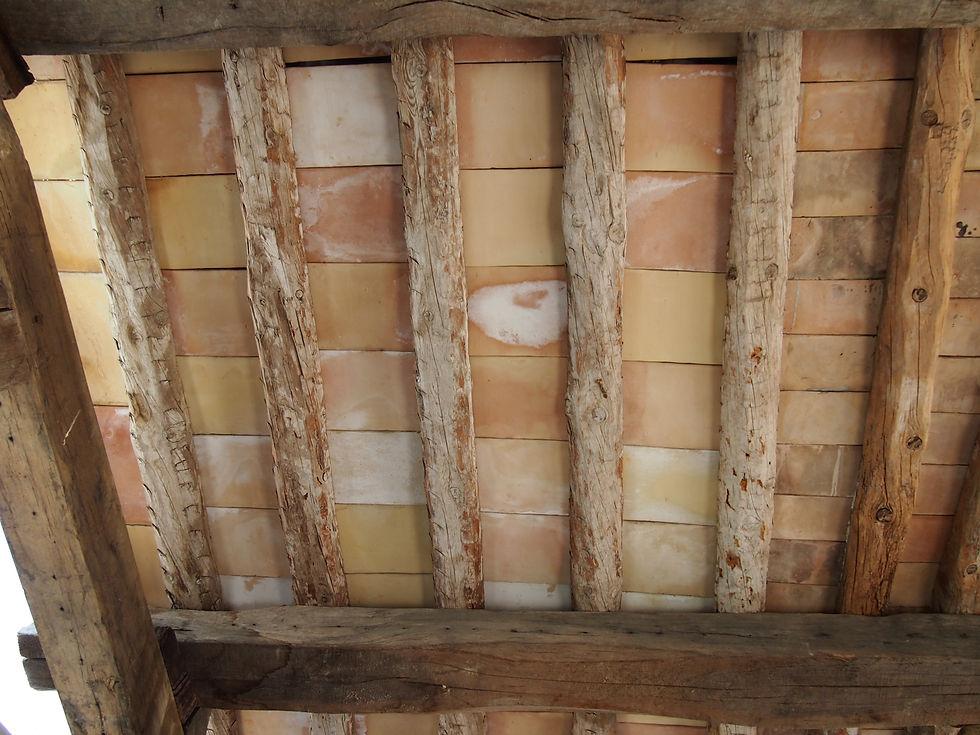
Traditional French ceiling construction using rectangular terracotta elements between exposed timber beams.
The change of use is an intriguing one. A tile once concealed in a roof or ceiling may later be laid in courses or broken bond in a room below. But former roofing use is no guarantee of suitability as flooring; thickness, soundness, abrasion resistance and installation conditions must all be assessed. This history is included as an example of the wider possibilities of reclaimed clay, not as evidence that De Ferranti’s rectangular brick products were originally roof tiles.
Seven Reclaimed Floors in the De Ferranti Collection
The seven antique terracotta surfaces in our collection share the appeal of recovered fired clay, but should not be treated as variations on a single French floor. The first two have specifically French provenance, four are identified more broadly as European, and Suffolk Pammets belong to a separate English tradition. In the next section we will introduce their colours, formats and setting-out possibilities; but actual dimensions, condition and available quantity should always be checked against the lot intended for the project.
Blanc Rose Terracotta
Blanc Rose is among the palest interpretations of antique French terracotta in our collection. Its square tiles combine cream and biscuit with weathered blush, softened pink, occasional muted red and traces of ochre. Their subdued colouring makes an interesting alternative to the stronger orange-red conventionally associated with fired clay. The apparent simplicity of the square format allows small differences in tone and edge condition to remain visible.
Recovered from historic French building stock dating as far back as the 17th century, the tiles retain the small variations that accompany earlier manufacture and use. A representative selection is especially important here: a single pale square cannot convey how rose, cream and darker markings will appear across a room. The floor can be laid in a regular grid or another pattern appropriate to the available material, with jointing and thresholds considered from the outset.
Hexagon Antique French Terracotta
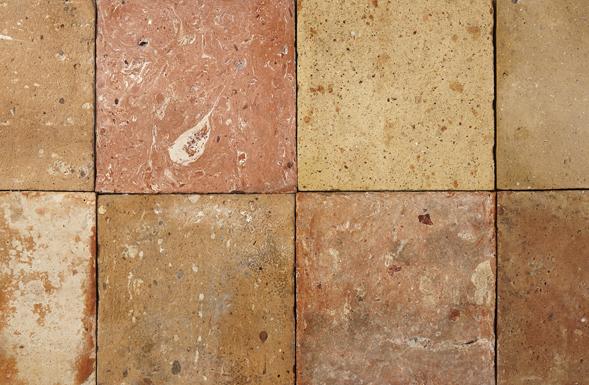
Blanc Rose Terracotta. Reclaimed antique French square tiles from the De Ferranti collection.
For a richer French palette, our antique French hexagons bring together warm reds, clay browns, biscuit and occasional smoke-darkened pieces. Many examples in this product’s sourcing history are described as approximately 200 to 300 years old, although a precise age cannot be assigned to every batch. Historic sources have included regions such as the Loire Valley, Bordeaux and Provence. The six-sided form gives these varied colours a clear, recognisable order.
Sizes are often around 15 or 20 cm across, with thickness commonly near 25 mm, but those measurements are indicative rather than a fixed specification. The worn edges and slight dimensional differences need room within the joint pattern, and the lot should be blended so that its darker and lighter pieces sit naturally together. The geometry suits rooms large and small, provided the perimeter has been carefully drawn.
Hexagons Blond
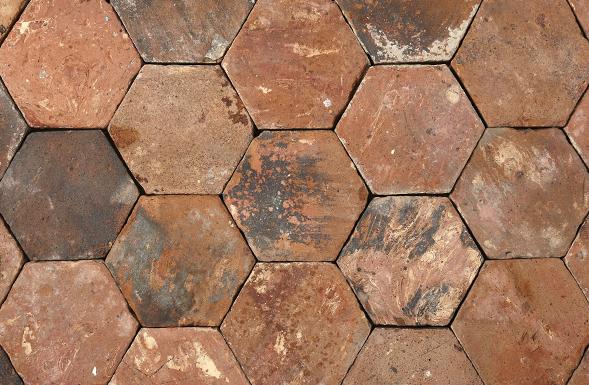
De Ferranti’s Hexagon Antique French Reclaimed Terracotta, showing its red, biscuit and dark fired-earth tones.
Hexagons Blond belongs to our wider European reclaimed selection, not to the specifically French group. Its colours are quieter than those of the French hexagons: chalky creams, pale biscuit, sand and soft clay tones, with occasional faint firing marks. Gently rubbed edges and surface irregularities keep the pale field from looking mechanically uniform, even when the hexagonal repeat is regular.
In an interior where deeper reds would dominate, this lighter honeycomb depicted below can sit comfortably beside lime plaster, timber or pale stone. The choice of grout is unusually visible against such restrained colouring, so joint width and tone deserve early attention. For floors or possible wall applications, the suitability and condition of the particular reclaimed lot should be confirmed before it is specified.
Bricks Blond
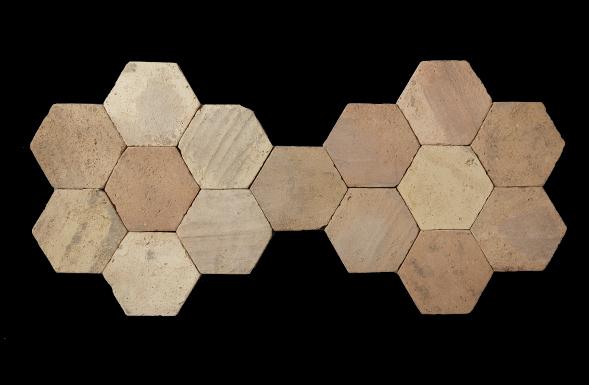
Hexagons Blond, a pale European reclaimed terracotta floor from De Ferranti.
There is something particularly appealing about the well-worn character of Bricks Blond. These European reclaimed terracotta bricks are laid in simple runs that keep attention on the individual pieces rather than an elaborate pattern. Their faces can be pitted and uneven, with softened or chipped edges, traces of old lime and marks associated with firing. This is a more emphatically weathered surface than the cleaner-looking blond formats.
The palette ranges through sand, biscuit, tobacco and warm clay to deeper, smoke-darkened browns. Differences in the length and edge condition of reclaimed bricks can make the courses slightly irregular, so a trial layout is useful before the floor is set out. It is a format well suited to passages and kitchens where the direction of the coursing can be allowed to follow the room.
Bricks Blond Courses
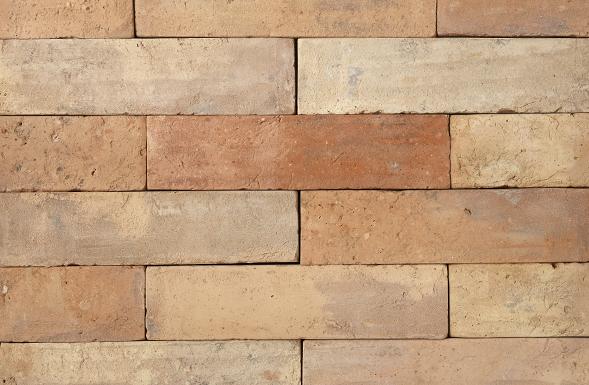
Bricks Blond. European reclaimed terracotta bricks laid in courses, with a varied pale and earthy palette.
Bricks Blond Courses presents a different surface from the longer Bricks Blond runs, with broader, more nearly square-looking pieces form an orderly arrangement of horizontal courses, making the changing colour and surface of the recovered clay the principal interest. Cream, pale biscuit, worn pink and weathered brown sit beside one another without the emphatic linearity of a long brick.
The composition is relatively quiet, although it still depends on the character of the individual tiles. Edges, surface condition and the proposed joints should be reviewed together, particularly where the setting out must meet a doorway or another floor finish. Its dimensions and the precise arrangement should be confirmed from the current batch, rather than assumed from the name alone.
Bricks Blond Basket Weave
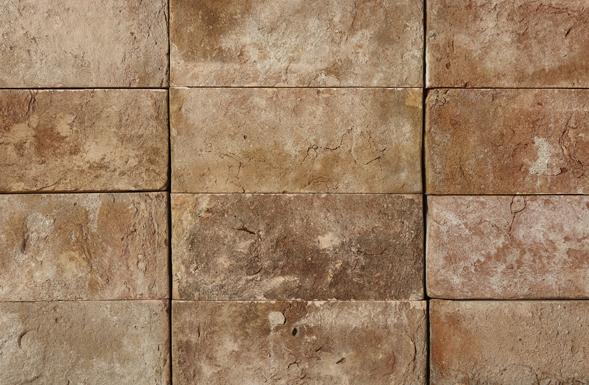
Bricks Blond Courses. A European reclaimed terracotta format, shown in its coursed arrangement.
The Bricks Blond Basket Weave gives the worn blond clay a stronger decorative structure. Rectangular pieces change direction from one grouping to the next, creating an interlaced effect that becomes apparent as the pattern extends across a room. The tiles themselves remain unmistakably reclaimed: their surfaces show subdued staining, rubbed areas and shifts from pale sand towards warmer brown and pink.
Here, the junction between groups matters as much as the colour of an individual brick. An irregular edge or unexpected difference in length can alter the pattern, making a representative dry layout especially valuable. Basket Weave offers a more articulated alternative to straight courses, but its visual effect comes from the way recovered pieces are arranged, rather than from ornament added to the clay.
Reclaimed Suffolk Pammets
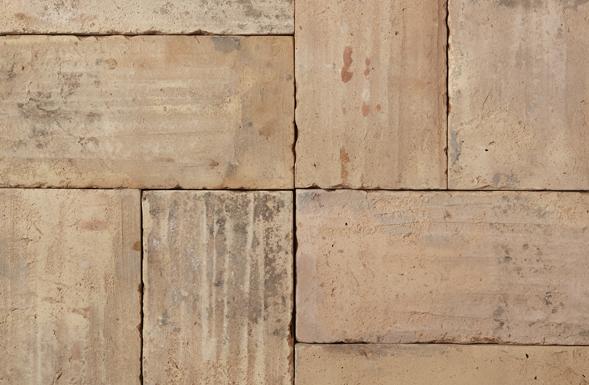
Bricks Blond Basket Weave. European reclaimed terracotta arranged in alternating directions.
Our Reclaimed Suffolk Pammets introduce an English tradition into a collection otherwise associated with continental clay. Historically associated with East Anglian floors, pammets are plain fired-clay tiles whose directness of form has long suited working and domestic buildings. De Ferranti’s reclaimed selection is described as a red and black clay floor, and its product photograph shows square units laid in a contrasting chequered arrangement.
The combination has a very different mood from the palest blond tiles or the red French tomettes. Deep, nearly charcoal-coloured pieces give the red clay a measured graphic rhythm, while the surface retains the slight variations expected of reclaimed material. Any installation must be designed around the actual recovered stock. As with all reclaimed terracotta surfaces pictured, the photograph below illustrates an arrangement, not a promise that every batch will have identical dimensions or an exactly matching blend of colour.
Patina, Provenance and the Condition of an Old Floor
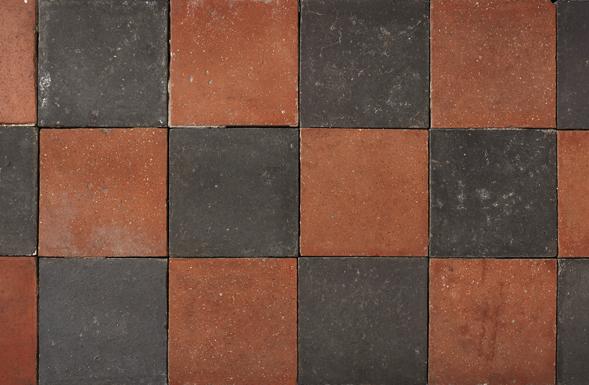
Suffolk red and black pammets, a naturally chequered English floor
Now that we have looked at the seven De Ferranti reclaimed terracotta surfaces, let us turn to the issue of patina, and whether a floor is truly reuseable. While it is true that a floors age invites curiosity, it is not always a certificate of quality. Gently worn surfaces can be stable and beautiful; crumbling faces, deep fractures or salts may indicate tiles unsuited to the proposed location. A worthwhile batch review includes its lightest and darkest examples, the most irregular pieces and those showing the greatest wear. Backs and edges deserve as much attention as the visible face.
The same discipline applies to provenance. A securely documented building of origin can be fascinating, especially when an entire historic floor survives as an ensemble. Without such evidence, a resemblance to tiles from a château, farmhouse or monastery does not establish that any particular batch came from one. It is better to describe the material as it is than to attach an attractive but unsupported history.
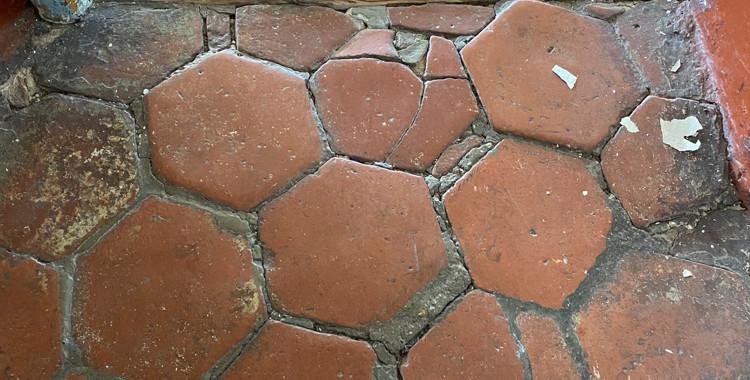
Historic hexagonal terracotta flooring at the Town Hall of Aix-en-Provence, showing irregular joints and surface wear.
Structural movement, moisture, soluble salts, abrasion and incompatible bedding are among the more common causes of damage to architectural tiles, which is particularly relevant where a floor remains within its original building. Conserving significant material in situ is a different task from installing salvaged tiles in a new interior, and a surviving historic floor should never be regarded simply as a source of saleable material.
Designing With a Finite Supply
It is essential to bear in mind that an antique terracotta lot is necessarily finite. Its nominal area may fall once damaged pieces are rejected, and further allowances may be necessary for cuts, irregular walls, perimeter details or a particular pattern. Unlike a new production run, replacement tiles that match the original batch may not be available after the floor has been laid.
That restriction can be a constructive part of the design. A smaller quantity of old clay might be concentrated in an entrance or dining room, with a complementary stone or newly made floor continuing elsewhere. A border may help resolve the proportions of an awkward space, while a change from hexagons to rectangular pieces can distinguish adjoining rooms. Such decisions need to be resolved before the recovered stock is cut or divided.
The useful questions are practical: what area is genuinely usable, which pieces should be excluded, what reserve is needed for future repairs, and how will variations in thickness be reconciled at thresholds? A trial setting out using representative pieces answers more than a nominal size alone. For a related but newly manufactured material, our Woodfired Terracotta collection explores other possibilities of traditional firing.
Where Antique Terracotta Flooring Works Best
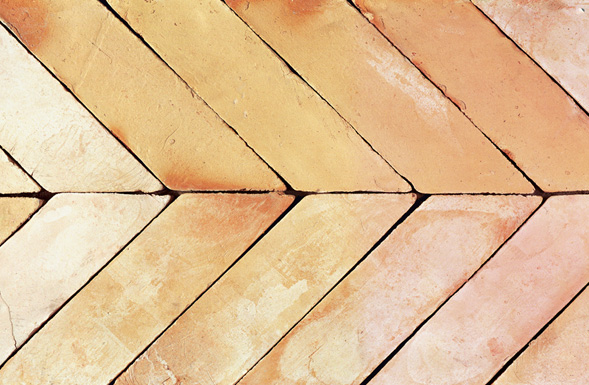
Woodfired Terracotta by De Ferranti. A newly manufactured alternative, not an antique reclaimed floor.
Antique clay need not be surrounded by exposed beams and rustic furniture. Against plain plaster, carefully proportioned joinery and well-chosen stone, its older surface can be particularly apparent. What once belonged to a farmhouse or working interior can take on an entirely different relationship with a contemporary room, without suggesting that the new setting has a history it does not possess.
Kitchens, entrances, dining rooms, garden rooms and boot rooms can all be suitable settings, provided the demands of use are considered. Cooking spills affect the choice of protection and cleaning; an entrance needs effective grit control; a frequently used passage places particular demands on soundness and wear. The appeal of an old floor should be accompanied by a sensible discussion of everyday maintenance.
The relationship with adjoining materials deserves similar care. Terracotta against limestone, marble, slate or timber brings differences of tone and surface, but also questions about thickness, movement and cleaning. Our Reclaimed Stone, Limestone & Marble Floors collection offers further historic materials for comparison.
Considerations When Specifying Reclaimed Terracotta
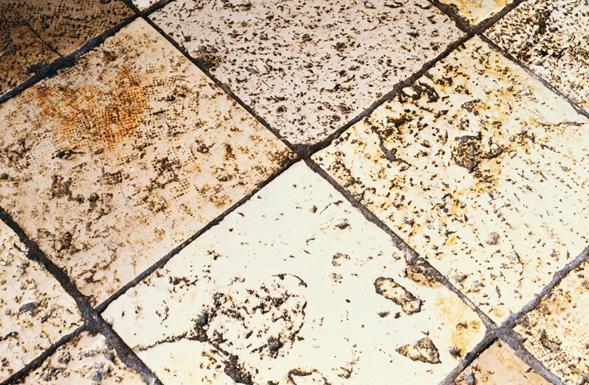
Antique Jerusalem Limestone, a historic-looking stone-floor alternative from De Ferranti.
The substrate, bedding, grout and any finishing treatment influence the performance of a floor as much as the visible tile. Reclaimed pieces may vary in thickness and cannot always be laid to the perfectly uniform level expected of calibrated modern ceramics. Installation must reconcile these differences while providing adequate support and safe transitions to neighbouring finishes.
Existing buildings demand additional care. Some historic floors managed moisture through relatively permeable layers, so introducing dense bedding or an impermeable membrane without understanding the surrounding construction may alter moisture movement through floors and walls. This does not prescribe a single traditional solution for every old property; it means the existing fabric must be assessed as a complete system, with conservation advice where appropriate.
A small dry layout using the actual tiles will reveal likely joint width, edge condition, colour distribution and perimeter details. It also allows the team to blend a lot rather than concentrating its darkest pieces in one corner. Movement joints in the substrate must be respected, while fixing materials and methods should be chosen for the individual tile, substrate and environmental conditions.
Jointing, Sealing and Everyday Care
The joint is more than a line between tiles. Irregular antique edges often make extremely narrow joints impractical, and a trial panel can establish a width and colour that accommodate the recovered material without allowing grout to dominate its appearance. The treatment of thresholds and boundaries deserves the same attention as the joints in the centre of the floor.
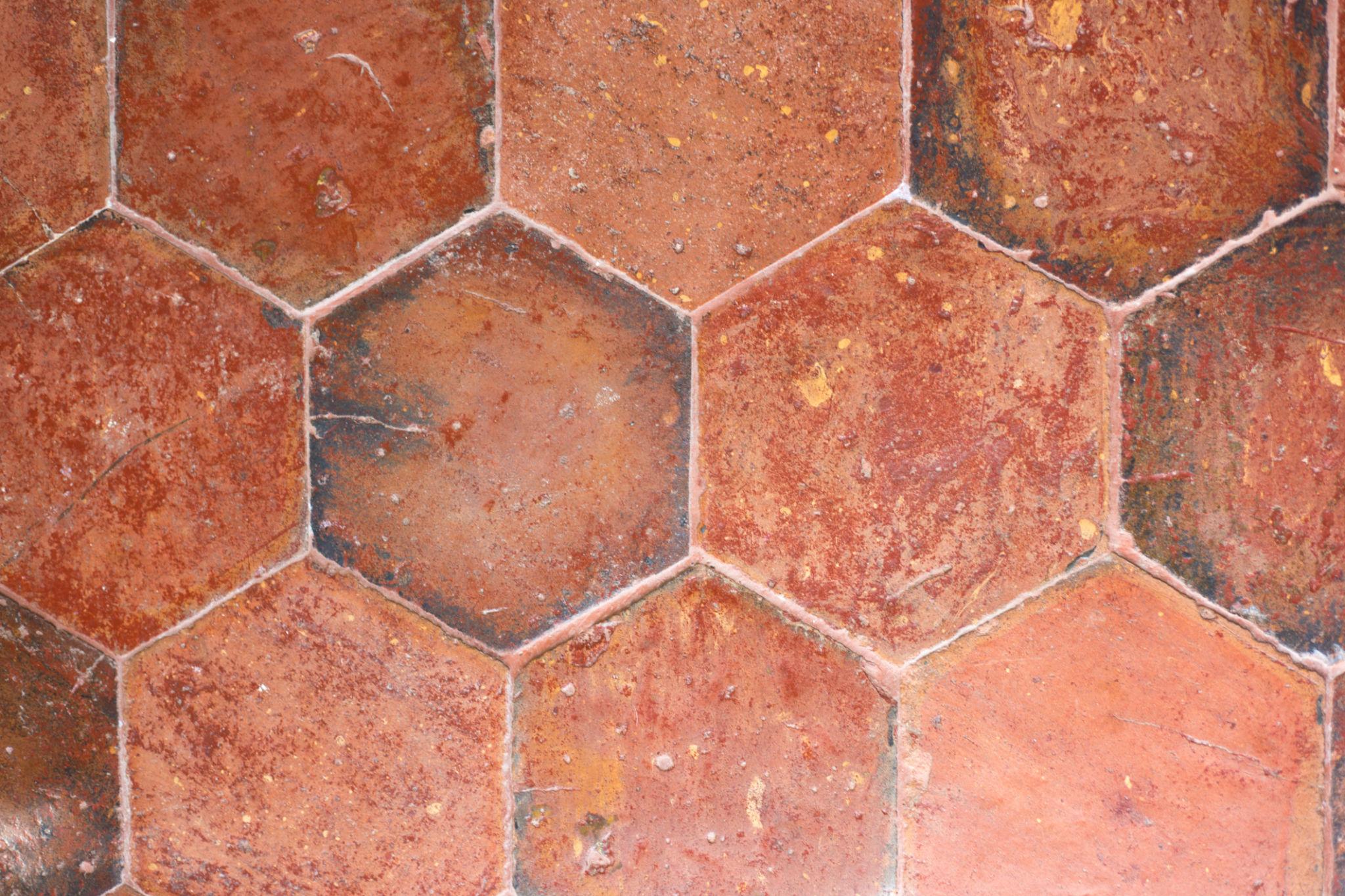
Traditional hexagonal terracotta flooring, showing softened edges, surface variation and the visual importance of the joints.
Unglazed terracotta is porous, so grout haze and staining must be considered. Depending on the selected clay and intended finish, an installer may propose a compatible pre-sealer or grout-release treatment. The full sequence should first be tested on spare tiles from the same batch. Some finishes deepen red and rose tones or introduce sheen, while others retain a dry, more mineral appearance; the choice should be judged after curing.
Maintenance should be agreed before occupation. Cleaning products must suit the clay and any sealer, and grit should be removed before it abrades the surface. Aggressive acids, abrasive products and mechanical polishing are inappropriate unless a specialist has approved the method. If salts, powdering or other deterioration appears, diagnosis is preferable to repeated cleaning. It is important to be cautious of over-wetting old floors; an original floor conserved in situ may also require a different approach to coatings from newly installed reclaimed material.
Heating, Wet Rooms and Exposed Locations
Underfloor heating may be possible beneath reclaimed terracotta, but the complete build-up must be designed together: substrate, bedding or screed, thickness, movement provision and controlled commissioning all affect the result. In an old building, changed temperature and moisture conditions deserve particular attention.
Wet rooms require properly designed waterproofing beneath the tiles; clay and grout cannot provide it on their own. Drainage falls, slip resistance, protection and cleaning must be assessed for the proposed use. Exterior settings call for equal caution. Exposure, drainage, frost and the soundness of the chosen batch determine suitability, and an attractive worn surface is no evidence of frost resistance.
Reuse and the Responsibility of a Second Life
A reclaimed tile has already been extracted, shaped and fired. Returning sound material to use can avoid making a replacement and preserve some evidence of older building craft. But recovery, cleaning, sorting, transport, breakage and installation also carry environmental costs. Age alone is not proof of a favourable environmental outcome.
There is also an ethical distinction between salvaging redundant material and removing a historically significant floor simply because its tiles have a market value. Where the original surface contributes to the understanding of a building, conservation in place may be preferable. A responsible second life respects both the fabric being left behind and the practical requirements of the next building.
Our Approach as Surfaceologists
At De Ferranti, our fascination with architectural surfaces extends well beyond their appearance. We are interested in the places they come from, the traditions of their making and the qualities that distinguish one material from another. Reclaimed terracotta is a particularly rewarding example of this approach, where each floor has its own history, and our role is to recognise what makes it exceptional, understand its possibilities and help find an appropriate place for it in a new architectural setting.
Our carefully curated reclaimed antique terracotta collection brings together distinctive examples from France, elsewhere in Europe and England, selected for their individual character and architectural possibilities. For those considering a broader palette of materials, we also invite you to explore our collections of Terracotta Floors & Walls and Reclaimed Stone, Limestone & Marble Floors.
Every project presents different opportunities and practical considerations. Whether you are working on a historic restoration or a contemporary interior, please contact us with your plans, approximate quantities and material preferences. We would be pleased to discuss the collection, share our knowledge and help you find a surface worthy of the architecture it will inhabit.
CPD Template for Architects
CPD Template for Architects
Logging This as CPD
If relevant to your role, current projects or wider professional development, this article may be recorded as unstructured CPD.
Suggested Core Topic
The historical development, craftsmanship, material characteristics and architectural specification of reclaimed antique terracotta flooring, examined through French, European and English clay-floor traditions and the seven products in De Ferranti's reclaimed collection.
Suggested Learning Format
Self-directed reading.
Estimated Reading Time
18–20 minutes.
This Article Covered
- The history and manufacture of terracotta flooring: How traditional clay preparation, hand moulding, firing methods and generations of use contribute to the colour, texture, dimensions and surface characteristics of reclaimed tiles.
- Genuine antique versus artificially aged terracotta: The distinctions between recovered historic material and newly manufactured tiles deliberately distressed to resemble older floors, including finishing techniques, availability and relative costs.
- French, European and English flooring traditions: The historical associations of French tomettes and hexagonal tiles, the use of parefeuilles in traditional construction, the character of European reclaimed brick floors and the distinctive regional tradition of English Suffolk Pammets.
- The seven De Ferranti reclaimed terracotta products: The differences in colour, format, wear and setting-out possibilities between Blanc Rose Terracotta, Hexagon Antique French Reclaimed Terracotta, Hexagons Blond, Bricks Blond, Bricks Blond Courses, Bricks Blond Basket Weave and Reclaimed Suffolk Pammets.
- Provenance, condition and material assessment: The importance of distinguishing attractive patina from deterioration, reviewing representative batches, understanding the limitations of historical attribution and assessing the suitability of recovered tiles for their proposed application.
- Architectural specification and installation: Planning around finite quantities, assessing tile dimensions and thickness variations, preparing suitable substrates, accommodating movement, determining joint widths and fixing methods, and integrating reclaimed terracotta with adjoining architectural finishes.
- Sealing, maintenance and environmental performance: Evaluating surface treatments, cleaning requirements, moisture behaviour, underfloor heating, wet-room applications and exterior exposure, alongside the conservation and environmental considerations associated with recovering and reusing historic materials.
Suggested CPD Record Summary
This article developed my understanding of reclaimed antique terracotta as a historic architectural material whose physical characteristics, provenance and previous use influence its suitability for contemporary specification. It examined traditional methods of clay preparation, hand moulding and firing, and the effects of prolonged wear on the appearance and condition of recovered tiles.
Through the seven products in De Ferranti's collection, I considered the distinctions between French, European and English reclaimed clay floors, including their different formats, colour ranges, surface characteristics and setting-out possibilities. The comparison between genuinely antique and artificially aged terracotta also clarified the relationship between material authenticity, availability and project budgets.
The technical guidance reinforced the importance of assessing the condition and usable quantity of reclaimed material before specification, particularly where variations in dimensions, thickness and surface wear may influence substrate preparation, installation methods, joints and adjoining finishes.
The article also highlighted the need to distinguish the conservation of historically significant floors in their original locations from the installation of salvaged material in new settings, and to consider the environmental implications of reuse without assuming that reclaimed materials are automatically the most sustainable option.
Suggested Reflection
How might a better understanding of historic clay-floor traditions, material provenance and the physical characteristics of reclaimed terracotta influence my approach to architectural specification?
What measures can I take during design development to accommodate the finite availability, dimensional variation and maintenance requirements of antique flooring while preserving its distinctive character?
How should the historical significance of existing architectural materials influence decisions about conservation, recovery and reuse?
Please Note
This article is intended for independent professional learning and may be recorded as unstructured CPD where relevant to the reader's professional requirements. It should not be treated as accredited CPD unless expressly stated otherwise.
CPD Template for Interior Designers
CPD Template for Interior Designers
Logging This as CPD
Where relevant to your professional practice, this article may be useful to record as self-directed or unstructured CPD.
Suggested CPD Record
Date Completed: [DD/MM/YYYY]
Activity Title: Reclaimed Antique Terracotta Flooring and Its Second Life
Provider / Publisher: De Ferranti
Format: Online article / self-directed reading
CPD Category: Unstructured CPD
Estimated Reading Time: 18–20 minutes
Link: [Insert published article URL]
What Did You Learn?
This article explored the history, craftsmanship and decorative character of reclaimed antique terracotta flooring, examining how traditional manufacturing techniques and generations of use contribute to the individuality of historic clay surfaces.
It explained the differences between genuinely reclaimed flooring and newly manufactured terracotta deliberately aged or distressed to resemble older materials. The discussion considered the physical characteristics of antique tiles, the techniques used to imitate historic wear and the implications of choosing between the two in terms of appearance, availability and budget.
The article also introduced the distinct regional traditions represented within De Ferranti's collection, from the pale French squares of Blanc Rose and the richer colours of antique French hexagons to the quieter tones of European Hexagons Blond, the worn surfaces and different arrangements of the three Bricks Blond products, and the contrasting red and black clay of English Suffolk Pammets.
These examples demonstrated how variations in tile format, surface texture, colour and joint arrangement can influence the character of an interior. They also showed how historic flooring can be incorporated into contemporary settings without necessarily recreating the architectural style of the building from which it originated.
The practical guidance addressed the selection and specification of reclaimed terracotta, including the importance of representative samples, assessing available quantities, setting out irregular tiles, selecting appropriate finishes and understanding installation and maintenance requirements.
Why Is This Relevant to Your Practice?
For interior designers, the article connects the historical and decorative qualities of reclaimed materials with the practical knowledge required to incorporate them successfully into contemporary interiors.
It demonstrates how the colour, scale and surface character of antique terracotta can influence the atmosphere of a room. Pale, softly worn tiles may create a restrained background for contemporary furniture, while richer red clay, dark hexagons or contrasting Suffolk Pammets can establish a more pronounced relationship between the floor and the surrounding architecture.
The different De Ferranti products also illustrate the importance of considering format and setting out alongside colour. Square tiles, hexagonal arrangements, coursed bricks and basket weave each produce a distinct visual effect, particularly when combined with the irregularities of recovered material.
Understanding the differences between genuine antique and artificially aged terracotta can help designers explain material choices to clients, assess budgetary priorities and establish realistic expectations concerning variation, availability and ongoing care.
The article also encourages closer consideration of how reclaimed terracotta relates to plaster, timber, natural stone, joinery and other architectural finishes. Knowledge of substrate requirements, jointing, sealing and maintenance can support more effective collaboration with architects, suppliers and installers.
Actions / Follow-Up
- Explore historic and contemporary applications: Consider how reclaimed terracotta might be incorporated into current or future interior projects, including both traditional buildings and contemporary architectural settings.
- Compare the seven De Ferranti products: Review the colour palettes, formats, surface characteristics and setting-out possibilities of the French, European and English reclaimed floors to identify suitable options for different interiors.
- Evaluate genuine antique versus artificially aged alternatives: Consider the differences in authenticity, appearance, availability and cost when recommending flooring materials to clients.
- Review representative samples: Assess groups of reclaimed tiles rather than relying on individual specimens, paying particular attention to colour distribution, surface wear, edge condition, thickness and compatibility with adjoining materials.
- Integrate specification considerations earlier: Include joint widths, substrate preparation, thresholds, sealing, maintenance and allowances for damaged or unusable tiles during design development.
- Consider material provenance and responsible reuse: Examine how the origins and condition of historic materials can inform specification decisions, while distinguishing appropriate salvage from the removal of architecturally significant original floors.
Suggested Reflection
How might a deeper understanding of reclaimed terracotta's historical origins, material variation and traditional craftsmanship influence my selection of flooring for contemporary interiors?
How can I make better use of differences in colour, tile geometry, surface wear and joint arrangements to establish a relationship between historic materials and contemporary furniture, finishes and architectural details?
What practical considerations should I address with clients and installers to ensure that the character of a reclaimed floor is preserved while meeting the requirements of everyday use?
Please Note
This article is intended for independent professional learning and may be recorded as unstructured CPD where relevant to the reader's professional requirements. It should not be treated as accredited CPD unless expressly stated otherwise.