

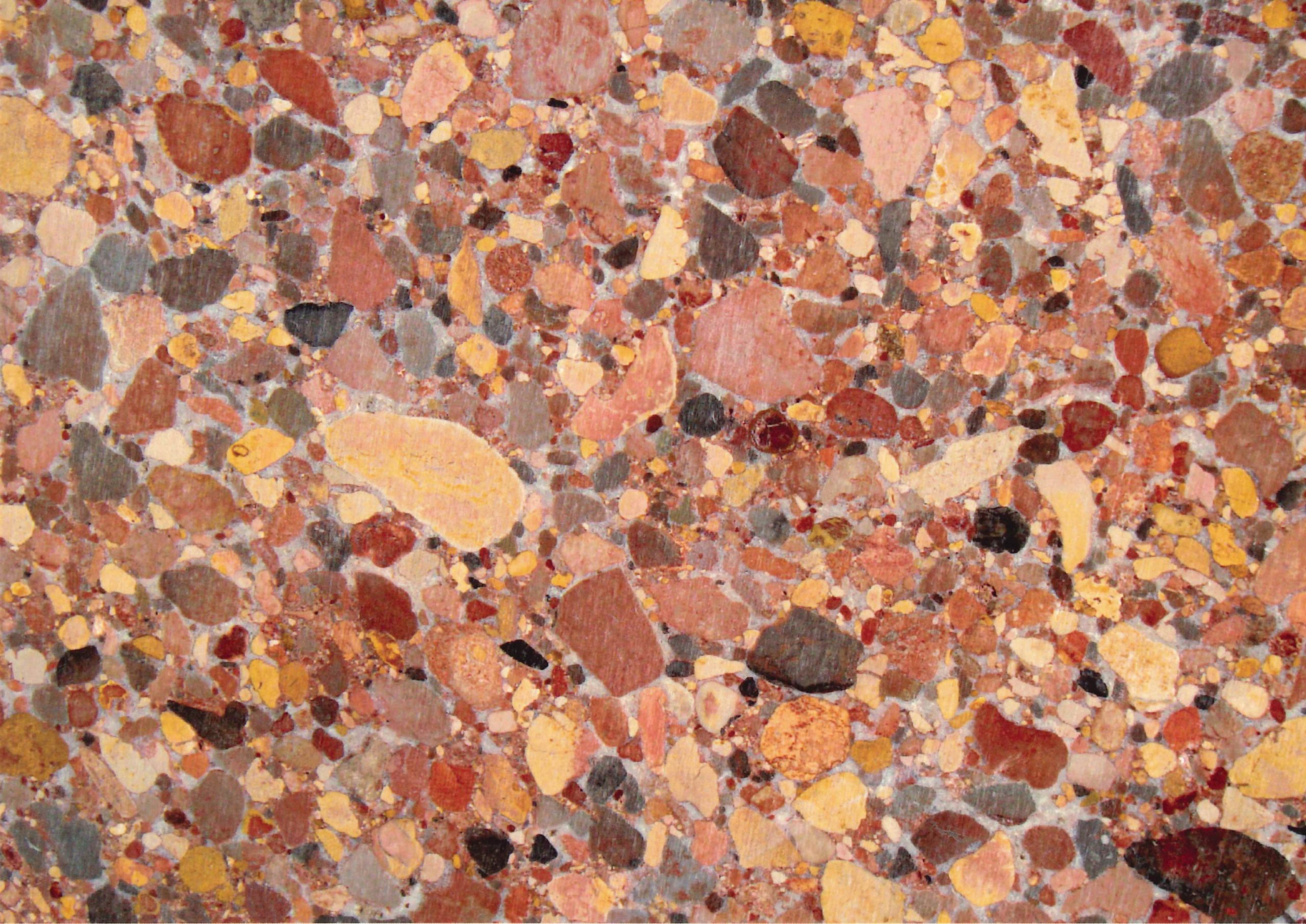
Brecha da Arrábida
Brecha da Arrábida, also known as Arabida, is one of Portugal’s rarest and most historically important ornamental stones. Quarried in the Serra da Arrábida near Setúbal, it has the visual richness of an antique , with fragments of red, ochre, cream, grey and deeper tones suspended within a warm natural matrix.
Although often called a in decorative stone language, Brecha da Arrábida is more precisely a conglomeratic . Its character comes from a broken, recomposed structure formed through geological processes, giving each slab the appearance of a natural rather than conventional veining.
Its use reaches back to the Roman period in the Setúbal region. Later it became associated with Portuguese Manueline and interiors. Important examples include the Monastery of Jesus and Fortress of São Filipe in Setúbal, Casa do Corpo Santo, the Convent of Christ, Funchal Cathedral and Pena Palace in Sintra. Quarrying has ceased, and the stone is now recognised as a heritage georesource, making surviving and available material particularly significant.
At De Ferranti, Brecha da Arrábida is treated as a collector’s stone for interiors where rarity, history and visual presence are central. It is especially suited to statement panels, fireplace surrounds, vanity tops, bathrooms, furniture and carefully composed decorative stonework.
Brecha da Arrábida in Material Schemes
For comparison, marble -onyx-collection-rare-luxury-antique/product/de-ferranti- -onyx-collection-rare-luxury-antique-historic- -policroma-rossa-2"> Policroma Rossa has a warmer red Italian character, while marble -onyx-collection-rare-luxury-antique/product/de-ferranti- -onyx-collection-rare-luxury-antique-historic-breche-de-medous">Brèche de Médous offers a darker Pyrenean . De Ferranti’s limestone - -floors">reclaimed stone, and floors and Pavements collection provide related routes into historic stone surfaces.
Selecting Individual Pieces
Because fragment size and colour vary markedly, review the actual available stone before cutting. Joint positions should respect the natural -like composition, particularly on large panels or furniture elements.
Project Guidance and Enquiries
For project guidance, availability, pricing, samples or further information, please use the Send E-Mail button below this description. Your enquiry will come directly to De Ferranti, and we will be pleased to discuss suitability, quantities, lead times and options for your project.
Product Applications
Get a call back
DE FERRANTI
South Park Studios - Suite 10
88 Peterborough Road, London SW6 3HH
United Kingdom