

The Art and Geometry of Cosmati Floors | De Ferranti
For Architects, Interior Designers and Project Teams
At De Ferranti, so much of what we do has you in mind. We know professional readers need more than attractive editorial. You need well-researched material insight that can support specification, spark design ideas, and add value to your CPD record. So we have done the research for you and turned that knowledge into something clear, useful and easy to apply.
To make that value immediate, we have also included two CPD-friendly templates at the end of the article: one for architects and one for interior designers. They are designed to help you log the learning quickly and with minimal effort.
We see architects, interior designers and project teams as important long-term partners and collaborators in the way we work, think and create.
Estimated Reading Time: 15 minutes
What Is a Cosmati Floor?
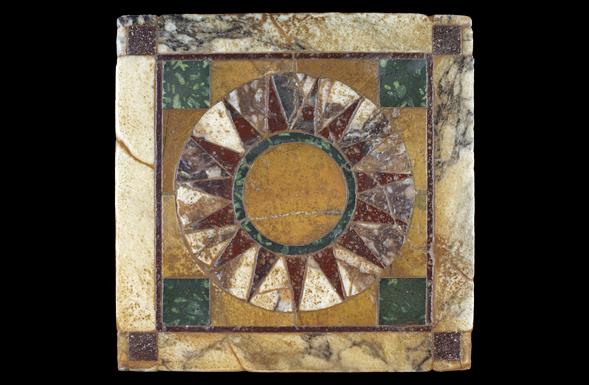
Bussola Cosmati Tile, De Ferranti
At its simplest, Cosmati describes a medieval Roman tradition of geometric marble, stone and mosaic work developed by specialist marble workers known as marmorari. For architects and designers working in luxury interiors, Cosmati floors can easily become overwhelming in their sheer intricacy. Their successful design and execution demand an understanding of craftsmanship, conservation and specification, as well as the careful orchestration of different stones, colours and sizes into an ordered composition that combines natural beauty with rigorous visual discipline.
The full scope of working with Cosmati floors could not possibly be covered in a single blog post, and for this reason, we suggest approaching this article as a primer in their fascinating world. Our aim is to introduce the history, materials and design language of Cosmati, alongside selected conservation and specification considerations, all intended to help readers develop ideas for the contemporary use of this rich and ancient tradition of working with stone.
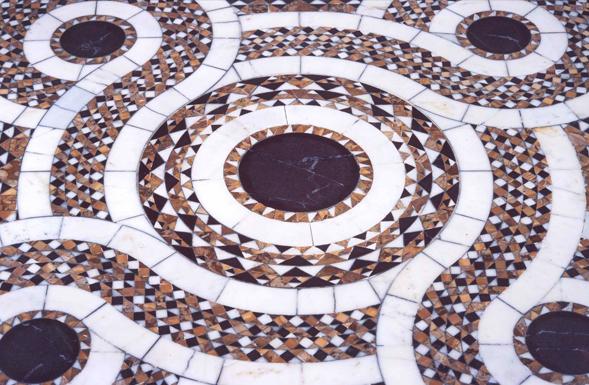
A Cosmati floor becomes immediately recognisable once we learn how to read one, and the easiest way to understand it is to begin with the largest shapes at the centre, allowing the smaller geometries to reveal themselves as the eye works gradually outwards.
We have included a more detailed glossary of terms at the end of this blog, before the CPD section, but for now, we will identify the main components that make up a Cosmati floor.
A rota is a circular disc of stone, frequently porphyry or another prized material, and often used as a focal point or axial marker.
The quincunx places one central rota within a group of four surrounding ones, creating a five-part arrangement that can anchor an entire room.
Guilloche patterns use looping or intertwining bands, while triangles, lozenges, chequers and zigzags occupy the secondary fields.
Material was equally important. Purple-red porphyry, green serpentine or green porphyry, white marble and other coloured stones supplied strong chromatic contrasts, while gold or coloured glass could add brilliance to liturgical work. The size and form of individual elements were often influenced by the antique material available for reuse.
The end result is that, when viewed from a distance, what appears to stand out most is its complex order and geometry, but when seen at close range it is easy to be mesmerised by the veining, colours, and material richness that make up the diverse composition of a Cosmati floor.
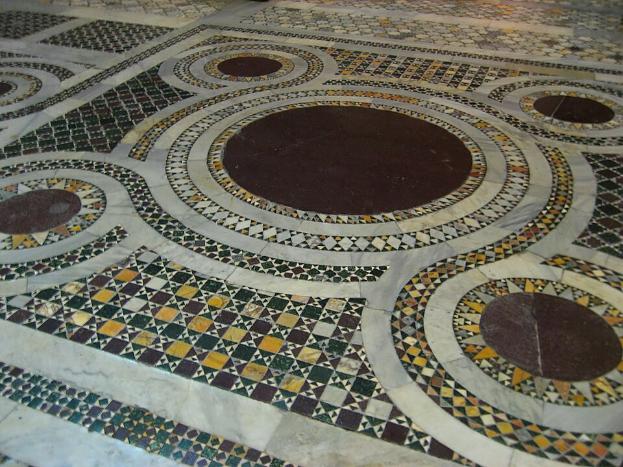
Basilica of Santa Croce in Gerusalemme, Rome. Large rotae are organised within bands of coloured marble and intricate geometric tesserae.
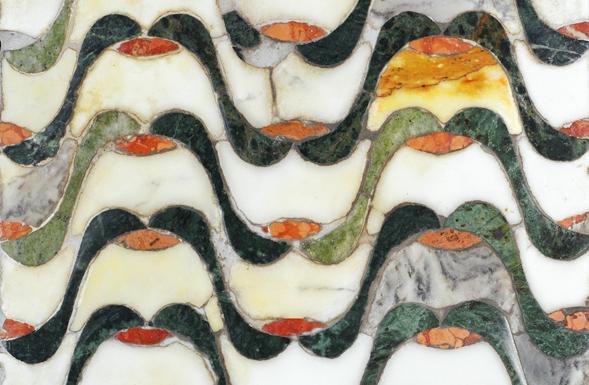
Intricate detail of different stones’ veining and colour in the Ondulate Cosmati Tile, by De Ferranti
The Cosma Families Behind the Name
Cosma comes from the Greek word “kosmas”; a word in ancient Greek which carried the sense of order, arrangement, harmony and ornament, as well as referring to the ordered world or universe.
That makes the name particularly apt in the context of Cosmatesque work because its root is linguistically connected with the idea of ordering and adorning, which is exactly what these craftsmen were doing with stone.
While the term “Cosmati” is relatively modern, having been coined in the 19th century, the medieval marmorari (marble-workers) themselves were citizens of Rome, often belonging to distinct family workshops and passing down their skills from one generation to the next. The term developed because the name Cosma, or Cosmatus, appears repeatedly among these craftsmen, and nineteenth-century historians began using Cosmati as a convenient collective description for the wider Roman tradition.
Two distinct families are particularly important in this context. Cosma di Iacopo di Lorenzo, active in the early thirteenth century, belonged to one of Rome's most celebrated marble-working dynasties and worked with his father at Civita Castellana and later with his sons at Anagni.
A later and separate figure, Cosma di Pietro Mellini, was active in the second half of the thirteenth century and directed work at the Sancta Sanctorum in Rome. Earlier scholars mistakenly treated these different craftsmen as members of a single continuous Cosma dynasty, helping to establish the collective name that survives today.
Therefore, Cosmatesque work was never the creation of one family alone. It was a broader culture of highly skilled Roman workshops, including the Vassalletto and others, sharing and developing a sophisticated language of coloured marble, geometry, mosaic and architectural ornament.
Rome, Recycled Materials and the Beauty of Stone
Many of the most precious materials in historic Cosmati floors were already old when the pavements themselves were made. Medieval Rome was filled with the remains of the ancient city, and temples, baths, villas and monumental buildings contained marbles originally brought from across the Roman Empire. Porphyry, green serpentine and coloured marbles acquired a second life when ruined or altered buildings became sources of material for medieval craftsmen.
In effect, Rome had become an immense architectural quarry. An antique column of imperial porphyry might be cut transversely to create circular discs; slabs could become borders, while smaller fragments were reduced to triangles, squares and tesserae. Pieces too small for conventional masonry became precious when incorporated into a larger geometric composition.
The result was a sophisticated economy of material in which scarcity became part of the design. For contemporary architects and designers, the lesson is less about copying medieval motifs than understanding how limitation and reuse can become sources of invention.
Opus Sectile, Mosaic and Inlay
Cosmati is often described as mosaic, but another important term is opus sectile, literally meaning cut work. Whereas a conventional mosaic is generally formed through the accumulation of many relatively small tesserae, in opus sectile the pieces themselves are deliberately cut into the shapes required by the design.
Cosmatesque work often combines the two approaches. Larger circles, triangles and strips create the principal geometry, while smaller tesserae occupy the spaces around them. The pattern is therefore not merely applied to the material; the material itself becomes the pattern, with colour coming from geological variation and geometry from cutting.
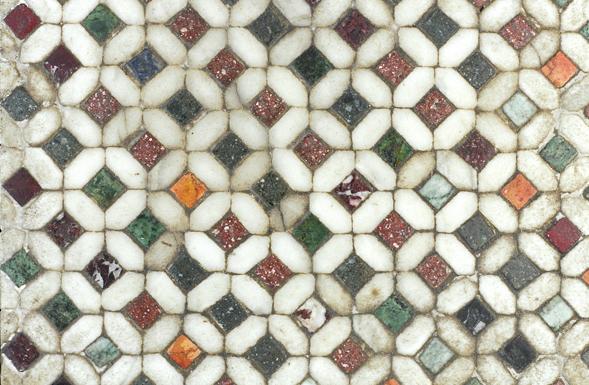
Arcobaleno Cosmati Panel, De Ferranti.
Cosmati Craftsmanship in the Monuments of Rome
Rome remains the essential place to understand Cosmati spatially. San Clemente is particularly valuable because the upper basilica survives with its Cosmatesque pavement and much of its medieval liturgical arrangement: large porphyry discs create a strong longitudinal datum through the nave, while increasingly intricate patterns concentrate attention toward the sanctuary. The basilica's own official site identifies the twelfth-century church and its Cosmatesque floor.
Other essential Roman encounters include Santa Maria in Cosmedin, San Lorenzo fuori le Mura, Santa Maria in Aracoeli, Santi Quattro Coronati, San Giovanni in Laterano (particularly its Vassalletto cloister) and San Paolo fuori le Mura, where the Vassalletto/Nicola d'Angelo Paschal candlestick demonstrates how the language migrated vertically from floors onto liturgical objects and architectural sculpture. The crucial point is that “Cosmati” was never just flooring: the same workshops made pulpits, choir screens, episcopal thrones, ciboria, portals, cloisters and tombs.
In Lazio, the Civita Castellana Cathedral is indispensable because inscriptional evidence anchors the genealogy: Jacopo and his son Cosma worked there in 1210. At Anagni Cathedral, Cosma is documented in 1231 with his sons Jacopo and Luca. These signed or dated works are far more reliable guides to workshop attribution than visual resemblance alone.
Westminster Abbey and a Roman Floor in England
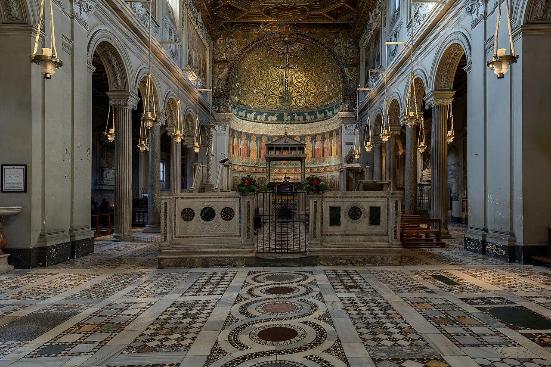
Cosmatesque pavement, Basilica di San Clemente, Rome.
One of the most important surviving Cosmatesque pavements is in Westminster Abbey. The sanctuary pavement in front of the High Altar was completed in 1268 during the reign of Henry III by Roman craftsmen led by Odoricus.
Measuring approximately 7.58 metres square, it is organised around a great quincunx and combines purple-red porphyry, green serpentine, limestone, onyx and coloured opaque glass. The Roman craftsmen adapted their language to an English Gothic setting, using dark Purbeck stone as a ground rather than the white marble more commonly associated with Italian examples. Even within its broad symmetry, the surrounding forms vary rather than repeat mechanically.
Venice, the Ziani Family and a Parallel Tradition
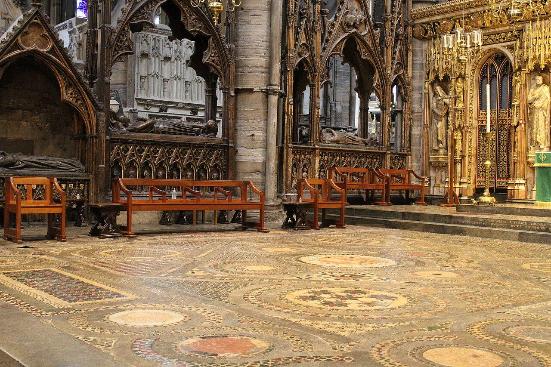
The Cosmati pavement, Westminster Abbey, London.
The magnificent medieval pavement of the Basilica di San Marco in Venice is often drawn into discussions of Cosmati, and visually the comparison is understandable. There is coloured stone, opus sectile, mosaic, complex geometry and extensive reuse of historic materials, all assembled within an architectural setting of extraordinary richness.
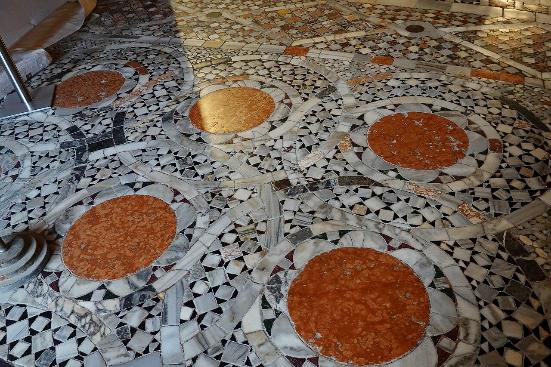
Medieval inlaid marble pavement, Basilica di San Marco, Venice.
The period also coincides with one of the great chapters in the history of the Ziani family. Sebastiano Ziani served as Doge of Venice from 1172 to 1178, while his son Pietro Ziani later served as Doge from 1205 to 1229. Sebastiano’s name is associated with the Peace of Venice of 1177 and is commemorated within the pavement of the basilica’s atrium.

Doge Sebastiano Ziani
The Ziani were closely connected to the political, commercial and architectural culture in which medieval Venice was being reshaped, and were major patrons of the arts. Under Sebastiano Ziani, the earlier Ducal Palace complex was substantially transformed and Piazza San Marco enlarged, although the surviving palace visible today is overwhelmingly the result of later Gothic rebuilding from the fourteenth and fifteenth centuries.
A small yet personal footnote connects the Ziani history to our De Ferranti brand, since the Ziani name has formed part of the de Ferranti family name since the nineteenth century, reflecting a long family tradition connecting the line with historic Venice, influencing the passion with which we presently dedicate ourselves to the sourcing, curation and preservation of exquisite, historic surfaces and their crafts.
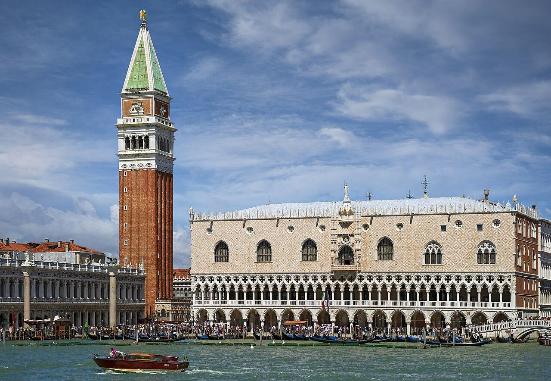
Palazzo Ducale and San Marco Campanile, Venice.
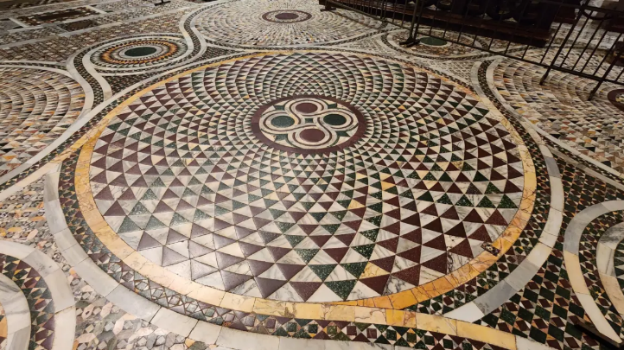
Cosmati floor detail, St Mark’s Basilica, Venice
In formal terms, although the San Marco basilica’s floor is often referred to as Cosmati, its pavement actually belongs to Venice’s distinctive relationship with Byzantium, Constantinople and the eastern Mediterranean, combining opus sectile and opus tessellatum within a specifically Venetian and Byzantine context rather than a single Cosmati workshop.
Rather than weakening the comparison, this makes it richer. Rome and Venice show how related materials, techniques and ideas could develop into different decorative languages according to geography, trade, patronage and cultural exchange.
Malta, Polychrome Marble and a Later Mediterranean Tradition
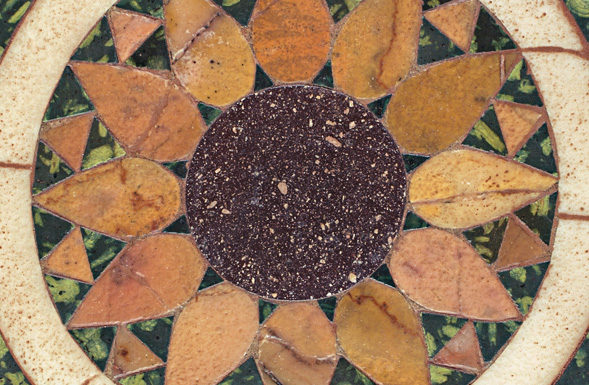
Sole Cosmati Tile, De Ferranti
A fascinating later parallel to Cosmati can be found in Malta, most spectacularly at St John’s Co-Cathedral in Valletta. Its extraordinary pavement is not Cosmati in the medieval Roman sense, but it demonstrates another way in which coloured stone, geometry, symbolism and architectural setting could be combined to transform a floor into one of the defining elements of an interior.
The floor contains hundreds of individual funerary monuments commemorating Knights and senior members of the Order of St John. From the early seventeenth century onwards, these were created as elaborate compositions of coloured inlaid marble, incorporating heraldry, inscriptions and allegorical images of mortality, honour and faith. The Co-Cathedral itself dates the coloured inlaid tombstones principally from the early seventeenth to late eighteenth centuries.
What makes the Maltese example particularly relevant to the story of decorative stone is its extraordinary international material palette. Historical research records marbles arriving from across Europe and the Mediterranean: red Diaspro di Sicilia from Messina, Belgian black, Giallo di Siena, French red marble, Spanish Broccatello and white Carrara marble, alongside other imported stones. The floor therefore became, quite literally, an assembly of different European geologies brought together in Malta.
There was an equally international exchange of craftsmanship. Documentary research shows that foreign marble workers could work in Malta using imported slabs or manufacture elements in their own workshops before sending them to the island for assembly and inlay. Records even describe seventeenth-century marble work imported from Messina incorporating carved interlaces and inserts, demonstrating how closely Malta remained connected to the sophisticated stone-working traditions of Sicily and Italy.
For architects and designers, the comparison with Cosmati is therefore not one of direct descent, but of a shared understanding of natural stone, cutting and inlay as vehicles for architectural expression.
Conserving and Specifying Cosmati Floors
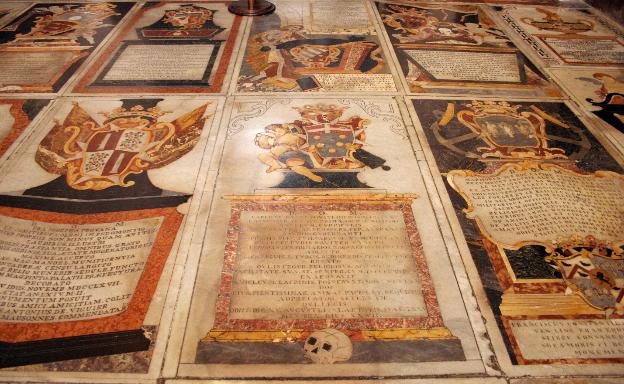
Inlaid marble tombstones covering the floor of St John’s Co-Cathedral, Valletta
The conservation of historic Cosmatesque floors reveals just how complex these pavements are as physical objects. At San Marco in Venice, the catastrophic acqua alta events of 2018 and 2019 provided a particularly dramatic example. Salt water penetrated the floor, causing bedding mortars to swell, marble elements to loosen and individual mosaic tesserae to move or disappear.
The subsequent conservation work was painstaking. Surfaces were washed with fresh water, salts gradually extracted using distilled-water poultices, voids injected and displaced tesserae carefully collected and reset. Unstable areas of mosaic were protected before being lifted, while detached sections were washed and monitored to determine how effectively salts were being removed. Missing pieces were documented and damaged joints repaired before sections of the pavement were carefully reinstated.
The work also revealed much about the construction beneath the visible surface. Traditional bedding included layers of sand, lime mortar, brick and cocciopesto, a lime-based material containing crushed brick or terracotta. Analysis of medieval bedding mortars identified air lime with sand and silicate aggregates, reinforcing the importance of understanding the original construction before attempting repair.
If working with historic Cosmatesque fabric, conservation must therefore begin with investigation rather than replacement. Individual fragments should be recorded, stone and mortar understood, and the causes of moisture or salt movement established before intervention begins. Wherever possible, historic material should be retained and compatible materials used for repair. At San Marco, this process was complicated by the presence of later cementitious bedding in some areas, which conservators had to distinguish from the original lime-based construction.
A newly commissioned Cosmati floor presents an entirely different challenge. There is no reason to reproduce medieval construction methods simply for the sake of historical appearance. Modern substrates, membranes and underfloor heating systems can coexist perfectly well with traditional stone cutting and craftsmanship, provided the technical decisions are considered from the beginning.
Setting-out is particularly important. Structural movement, floor build-up and underfloor heating should be resolved before fabrication, while the physical properties of the stones need to be considered alongside their colour and character. Full-size drawings can establish the relationship between the design and the architecture, allowing movement joints to coincide, where possible, with borders or major divisions within the pattern. Complex panels may also benefit from being dry-laid before installation so that colour, geometry, joints and overall composition can be assessed together.
Material choice deserves the same care. One of the defining qualities of historic Cosmati is that the colour belongs to the stone itself. Porphyry, serpentine, marble and other naturally coloured stones provide depth and variation that pigments or printed imitation cannot reproduce. Historic red porphyry has particular resonance within the tradition, but genuinely antique material should never be treated as an unlimited resource. Contemporary stones can provide sympathetic alternatives, while reclaimed historic material should always have clear and responsible provenance.
There is also something to be learned from the slight irregularities of the originals. Modern waterjet cutting can achieve a degree of mechanical precision that medieval craftsmen neither possessed nor necessarily sought. In a contemporary Cosmati floor, absolute uniformity can sometimes remove the very quality that makes the historic examples so compelling. Small variations in tessera size, joint character, veining and tone allow the hand of the maker and the individuality of the stone to remain visible.
The objective is not imperfection for its own sake, but a balance between technical control and material character. A successful contemporary Cosmati floor should feel carefully resolved without becoming sterile, preserving something of the human rhythm and natural variation that give the great historic pavements their extraordinary depth.
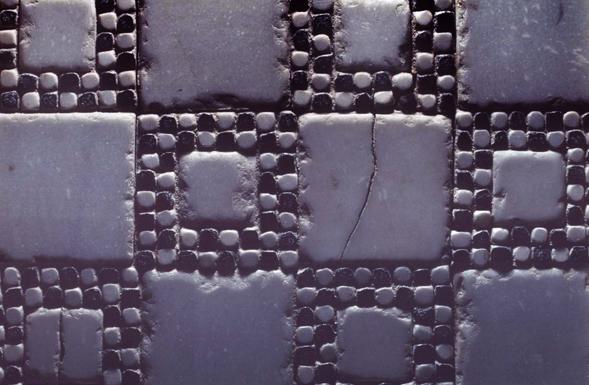
Chequerboard Cosmati and Mosaic Panel, De Ferranti
Where Cosmati Floors Work Best
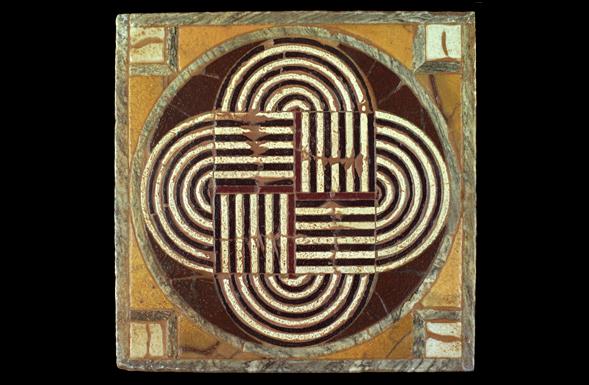
Nodo Cosmati Tile, De Ferranti
Cosmati can work in far more types of interior than its ecclesiastical history might suggest. Entrance halls suit central compositions that establish an axis on arrival, while galleries and corridors can use elongated borders and directional patterns. Formal reception rooms can support a more ambitious pavement, while bathrooms and cloakrooms allow intricate stonework to become concentrated and jewel-like, provided the material and finish suit the wet-area specification.
In contemporary minimalist interiors, a single highly worked floor, medallion or border can provide enough visual richness without making the room feel historically themed.
The De Ferranti Philosophy
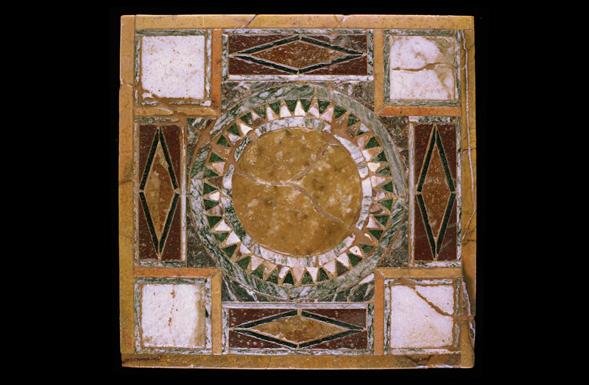
Quattro Angoli Cosmati Tile, De Ferranti
Cosmati sits at the heart of many of the ideas De Ferranti has always cared about: material, craft, architectural pattern and the continued relevance of old techniques when they are understood rather than mechanically reproduced. For us, its contemporary value lies in carrying that discipline forward through real stone, considered proportion, visible craftsmanship and a close relationship between the floor and the architecture around it.
Although this article focuses on Cosmati, it belongs to a wider De Ferranti conversation around mosaic, stone inlay, semi-precious materials and historically informed architectural surfaces.
If you would like to discuss pattern, room scale, stone selection, samples, setting-out or how a bespoke Cosmati floor might sit within a wider material scheme, please contact us at De Ferranti for an initial conversation.
Cosmati Glossary
Cosmati / Cosmatesque
Terms used for the distinctive tradition of geometric marble and mosaic work associated principally with the medieval Roman marmorari.
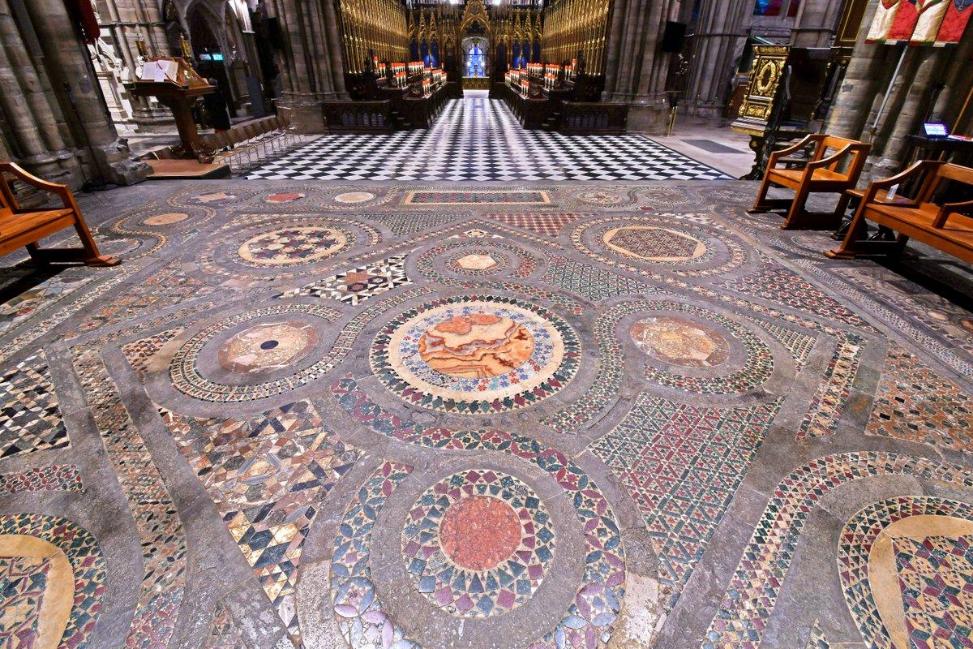
Cosmati Pavement, Westminster Abbey, 1268.
Marmorari
The specialist marble workers of medieval Rome whose family workshops produced architectural stonework, pavements and mosaic decoration.
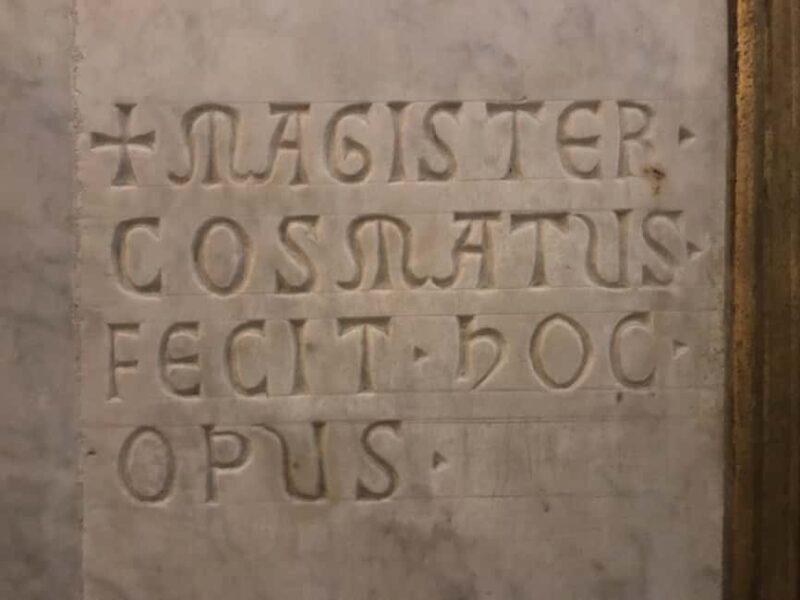
Signature of Magister Cosmatus, Rome.
Opus sectile
Literally “cut work”. A technique in which stone or other materials are cut into specific shapes to form a design, rather than building an image entirely from small mosaic pieces.
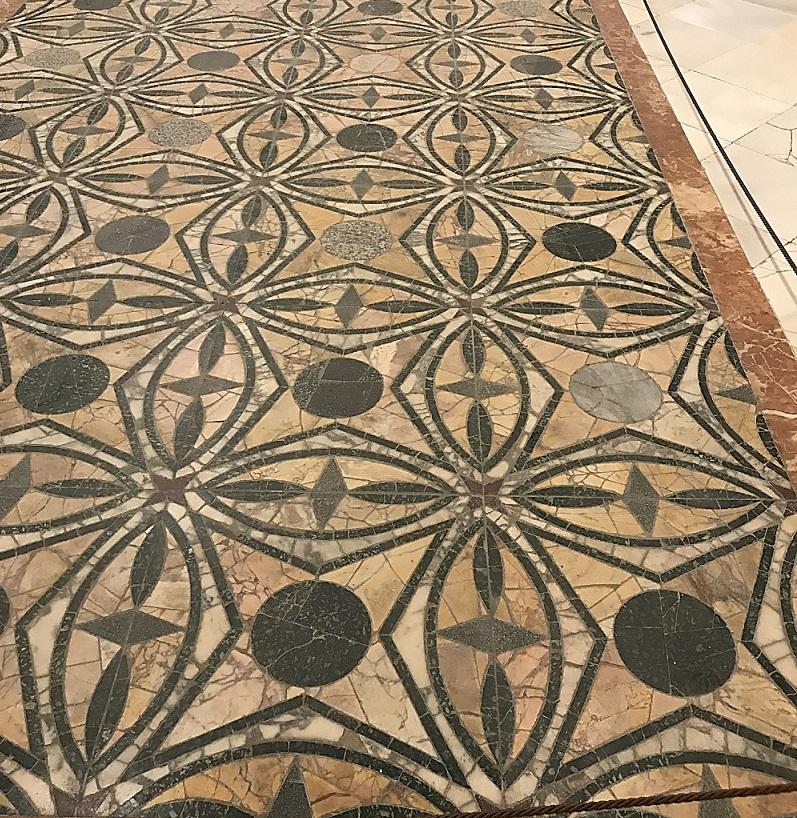
Roman marble pavement, Itálica, Spain.
Opus tessellatum
Mosaic work composed principally from small, regularly shaped pieces known as tesserae.
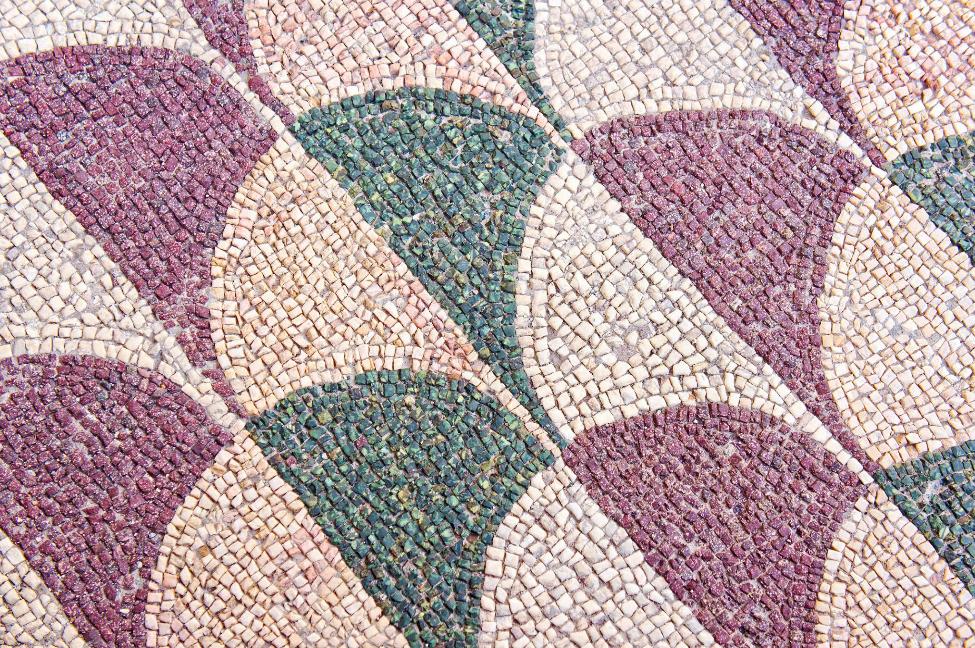
Roman mosaic, Baths of Caracalla.
Tessera / Tesserae
A single small piece, or multiple pieces, of stone, marble, glass or other material used to construct a mosaic.
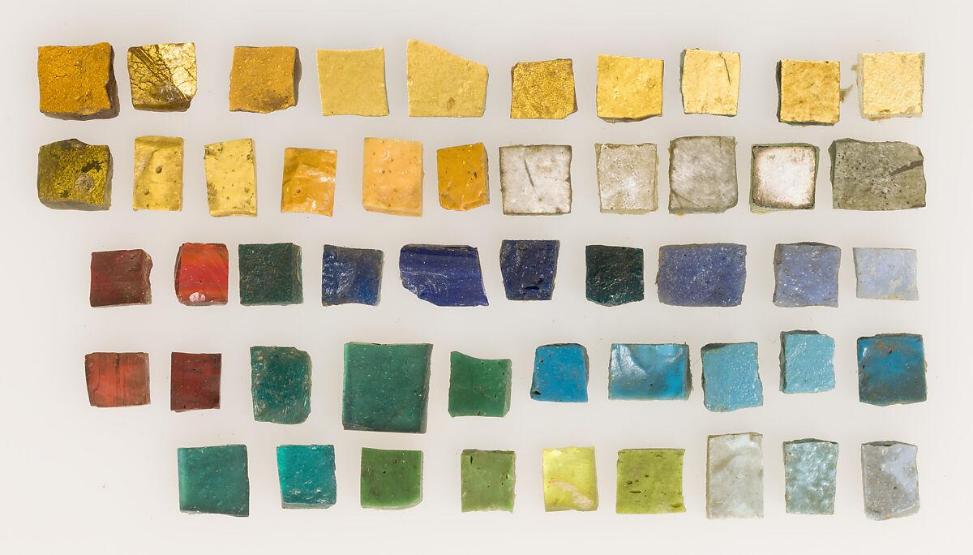
Byzantine mosaic tesserae.
Rota / Rotae
A circular stone disc used as an important compositional element in Cosmatesque floors, often made from porphyry or another prized stone.
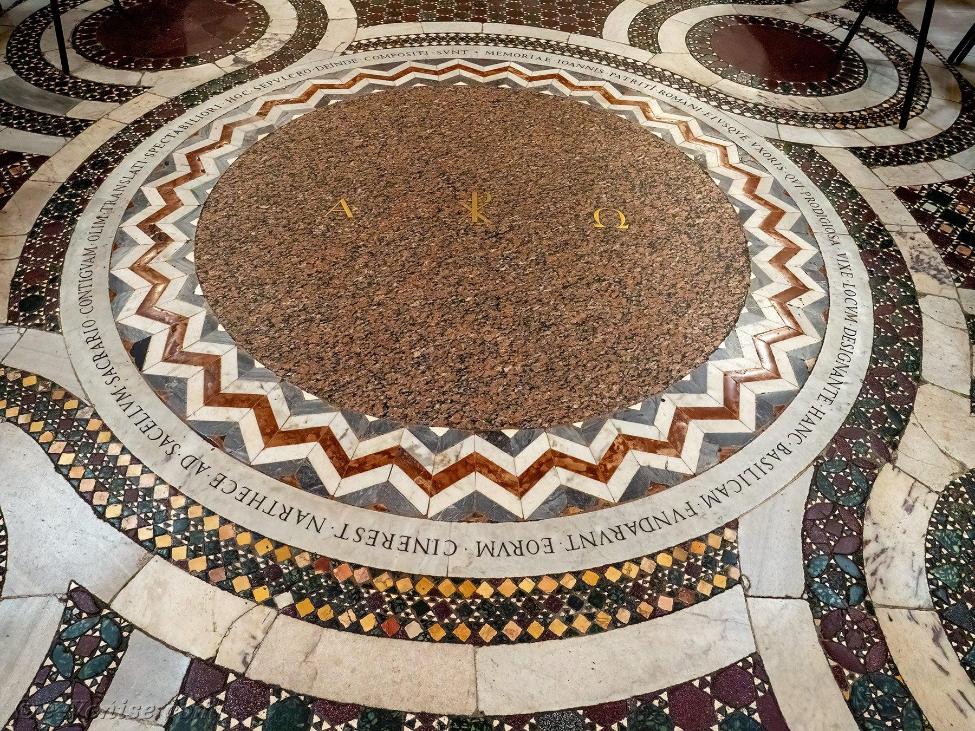
Cosmatesque roundels, Santa Maria Maggiore, Rome.
Quincunx
A five-part geometric arrangement consisting of a central element surrounded by four others, comparable to the five on a die.
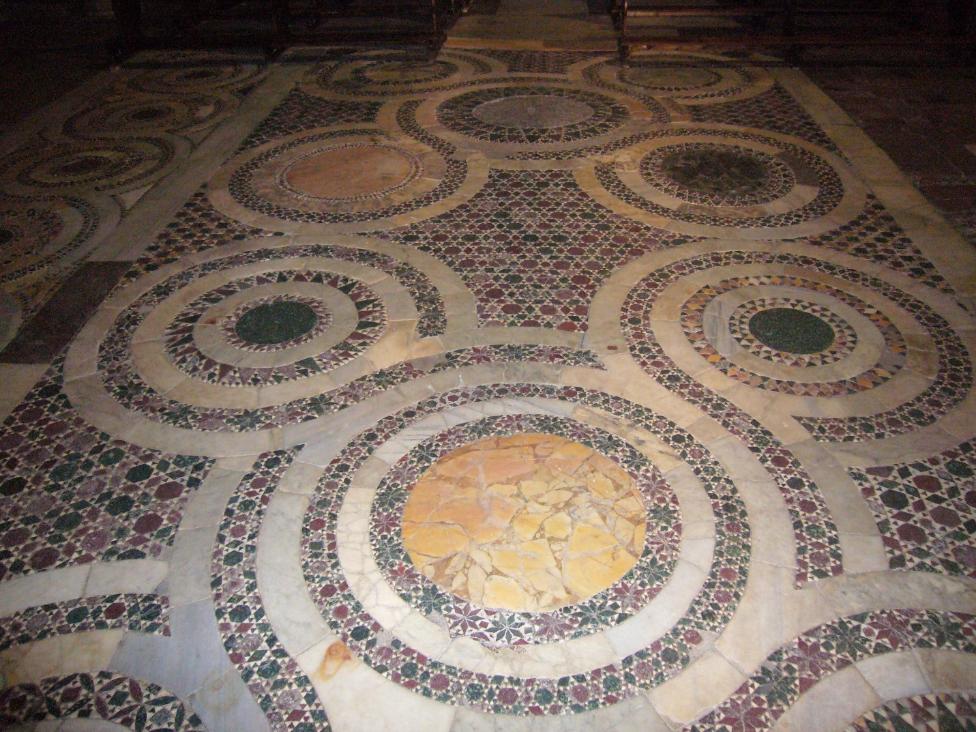
Cosmatesque roundels, Santa Maria Maggiore, Rome.
Guilloche
A decorative pattern formed from two or more interlacing or overlapping bands. In Cosmatesque work, guilloche bands frequently weave around circular stone discs, creating rhythmic linear sequences across floors, screens and architectural furnishings.
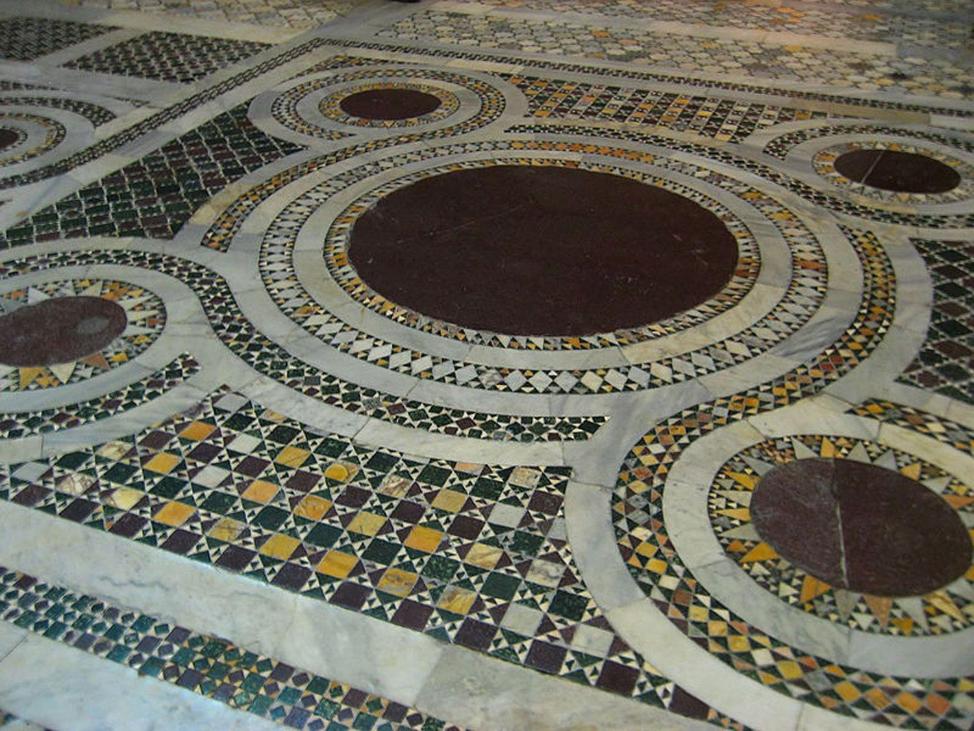
Cosmatesque guilloche, Terracina Cathedral.
Porphyry
A prized purple-red igneous stone strongly associated with imperial Rome and frequently reused by medieval craftsmen.
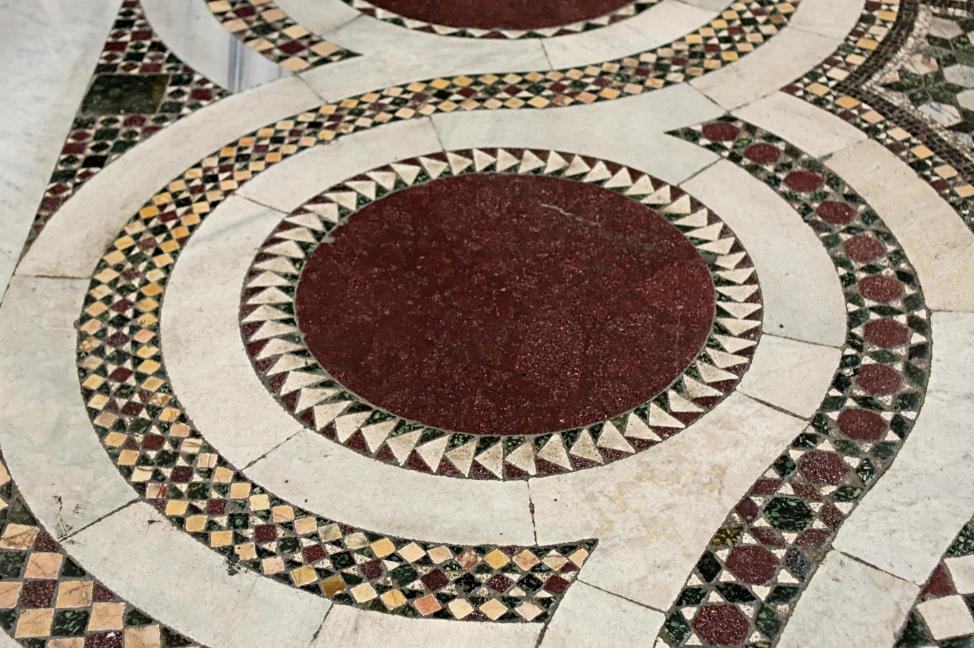
Porphyry roundel, Santa Maria Maggiore, Rome.
Serpentine
A characteristically green stone used extensively as a chromatic counterpoint to porphyry in Cosmatesque work.
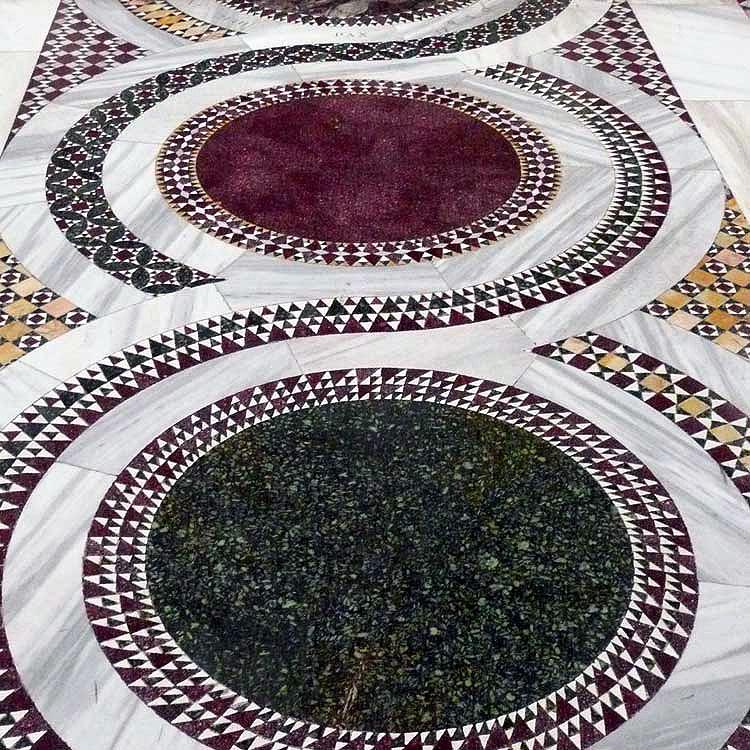
Green serpentine roundel, San Clemente, Rome.
Intarsia
A form of decorative inlay in which pieces of contrasting material are fitted together to create a pattern or image. This becomes particularly relevant when thinking about the Maltese polychrome marble tradition.
CPD Template for Architects
CPD Template for Architects
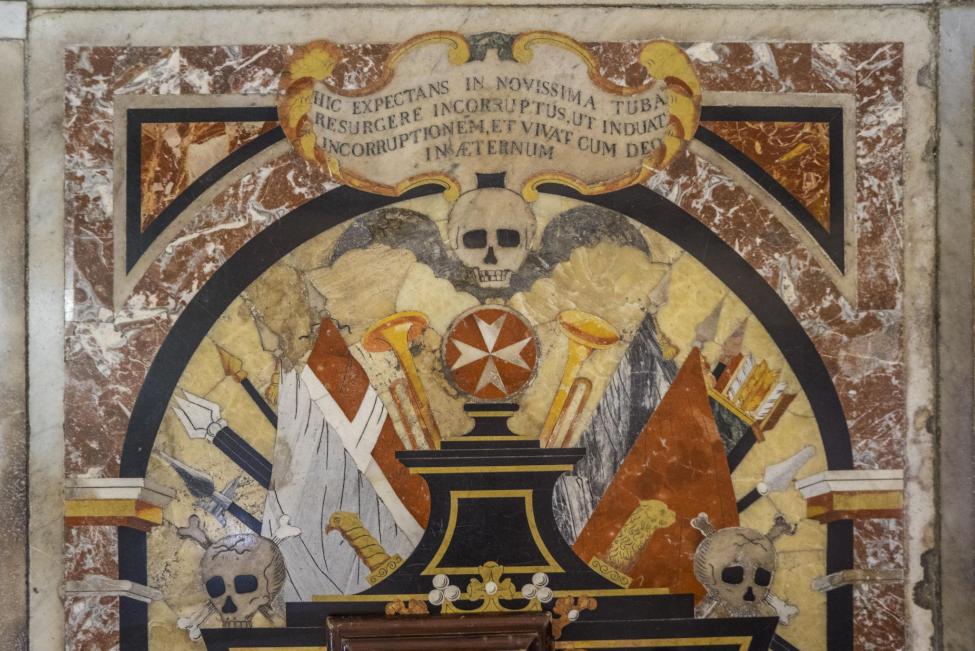
Polychrome marble intarsia, St John’s Co-Cathedral, Malta.
Logging This as CPD
If relevant to your role, current projects or wider professional development, this article may be recorded as self-directed or unstructured CPD.
Suggested Core Topic
The history, material composition, geometric design, conservation and contemporary specification of Cosmati and Cosmatesque stonework.
Suggested Learning Format
Self-directed reading.
Estimated Reading Time
15 minutes.
This Article Covered
- The origins of Cosmati and the medieval Roman marmorari responsible for developing the tradition.
- The origin of the term Cosmati and the role of the Cosma families and related Roman workshops.
- The relationship between Cosmati, mosaic, opus sectile, tesserae and architectural inlay.
- The reuse of ancient Roman marbles and the importance of porphyry, serpentine and other coloured stones.
- Key geometric elements including rotae, quincunxes and guilloche patterns.
- Important surviving examples in Rome, including San Clemente and works associated with the Vassalletto workshops.
- The significance of the 1268 Cosmatesque pavement at Westminster Abbey.
- The relationship between Roman Cosmatesque work and the related but distinct traditions of medieval Venice.
- The later use of polychrome marble and inlay at St John’s Co-Cathedral in Valletta.
- Conservation lessons from the historic pavements of San Marco, including moisture, salts, bedding mortars and the retention of original material.
- Contemporary specification considerations including stone selection, setting-out, substrates, movement, underfloor heating, dry-laying and specialist installation.
- The importance of balancing technical precision with the natural variation and visible craftsmanship characteristic of historic Cosmatesque work.
Suggested CPD Record Summary
This article developed my understanding of Cosmati and Cosmatesque stonework as both a historic architectural tradition and a contemporary design and specification discipline. It examined the origins of the craft among the medieval Roman marmorari, the development of the name Cosmati, the reuse of ancient coloured stones and the relationship between opus sectile, mosaic, geometry and architectural setting.
It also considered important surviving examples in Rome, Westminster Abbey and Venice, together with the later polychrome marble tradition of Malta. From a technical perspective, the article explored conservation issues affecting historic pavements and the practical requirements of specifying new Cosmati-inspired floors, including material selection, substrates, movement, underfloor heating, setting-out and specialist installation.
Suggested Reflection
How might the principles of Cosmati influence the way I design or specify decorative natural stone floors?
I would consider how material hierarchy, geometric setting-out, architectural axes, thresholds and sightlines could be incorporated into the design process from an early stage, rather than treating the floor as a decorative finish selected after the architecture has been resolved.
I would also consider how modern construction tolerances and installation systems can be balanced with the natural variation, hand-cut character and material individuality that give historic Cosmatesque work much of its visual depth.
Please Note
This content is intended for independent professional learning and should not be treated as accredited CPD unless expressly stated otherwise.
CPD Template for Interior Designers
CPD Template for Interior Designers
Where relevant to your professional practice, this article may be useful to record as self-directed or unstructured CPD.
Suggested CPD Record
Date completed: [DD/MM/YYYY]
Activity title: The Art and Geometry of Cosmati Floors
Provider / publisher: De Ferranti
Format: Online article / self-directed reading
CPD category: Unstructured CPD
Estimated Reading Time: 15 minutes
Link: [Insert article URL]
What Did You Learn?
This article explored Cosmati as a decorative stone tradition in which natural material, geometry and architecture are closely connected. It examined how medieval Roman craftsmen reused coloured marbles from ancient buildings and transformed them into complex compositions of circles, bands, tesserae and geometric inlay.
It introduced important terminology including marmorari, opus sectile, rota, quincunx and guilloche, while examining important examples in Rome, Westminster Abbey, Venice and Malta.
The article also considered how the principles behind historic Cosmati can inform contemporary interiors, including the use of focal points, borders, medallions, material hierarchy, natural stone variation and the relationship between floor pattern and the architecture of a room.
Why Is This Relevant to Your Practice?
For interior designers, Cosmati provides a useful example of how a floor can contribute to the organisation and character of an interior rather than functioning simply as a surface finish.
Scale, colour, geometry and material can be used to reinforce entrances, axes, thresholds and focal points, while a carefully controlled palette of natural stone can introduce richness without overwhelming the room.
The tradition also demonstrates the value of balancing precision with natural variation. Veining, tonal movement and subtle differences in hand-cut stone can give a geometric composition depth and individuality that would be lost through excessive uniformity.
Actions / Follow-Up
- Review the architecture of a room before selecting a decorative floor pattern, paying particular attention to entrances, axes, thresholds and principal sightlines.
- Consider whether a full Cosmati pavement, central medallion, border or smaller geometric panel would be most appropriate to the scale and character of the space.
- Develop the stone palette through a clear hierarchy of materials rather than selecting multiple stones of equal visual strength.
- Review natural stone samples in person, paying attention to veining, tonal movement, finish and the relationship between adjacent materials.
- Consider commissioning a sample panel or dry-lay for complex bespoke floors before full manufacture.
- Coordinate floor build-up, underfloor heating, movement requirements and thresholds early in the design process.
- Consider how natural variation and visible craftsmanship can be retained without compromising the technical performance of a contemporary installation.
Please Note
This content is intended for independent professional learning and should not be treated as accredited CPD unless expressly stated otherwise.