

Ezel Bistre
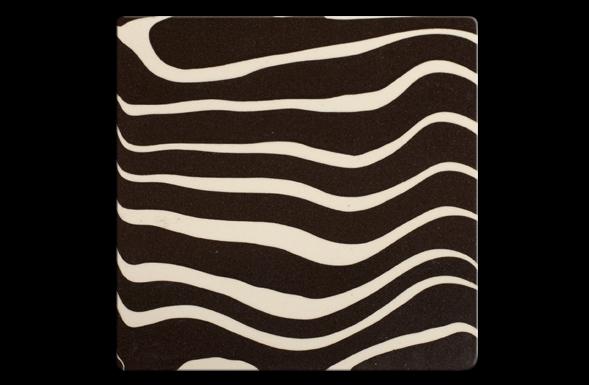
The bistre striped Delft tile is hand-painted with a smooth and strikingly contemporary pattern based on 17th century Delft originals. These traditional yet modern wall tiles have been sourced by De Ferranti from a small family firm that specialises in the production and research of old Delft ceramics.
This type of tile was traditionally used at skirting level in houses in the Netherlands because the ceramic kept damp at bay more effectively than timber. Another popular use was within wall panels behind open fireplaces, where the tiles became very sooty but, usefully, did not readily show the marks.
After being layered with manganese or an iron ferrous engobe, each tile is dried and baked at 1,000 degrees C before being glazed and baked once more at a very high temperature. Despite its historic source, the design looks distinctly contemporary.
Bistre Striped Delft Tile with Flowing Lines
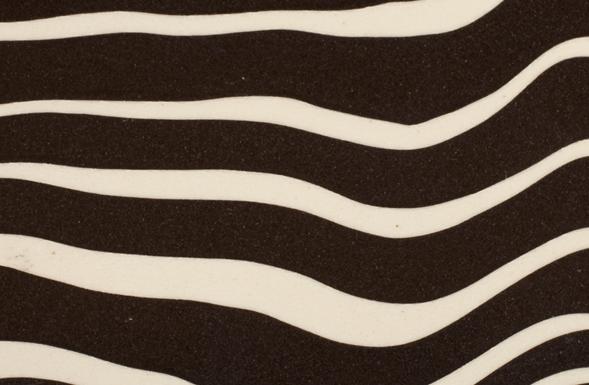
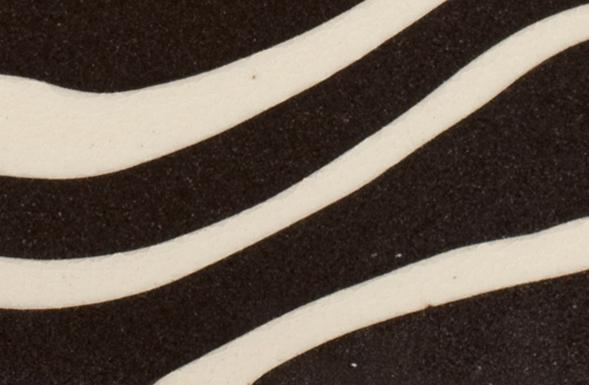
The surface is divided into broad areas of deep brown and irregular pale lines. These lines change in width and curvature as they travel across the tile, creating movement without forming a rigid geometric repeat. The strong contrast keeps the design graphic, while the hand-painted variation prevents it from appearing mechanically uniform.
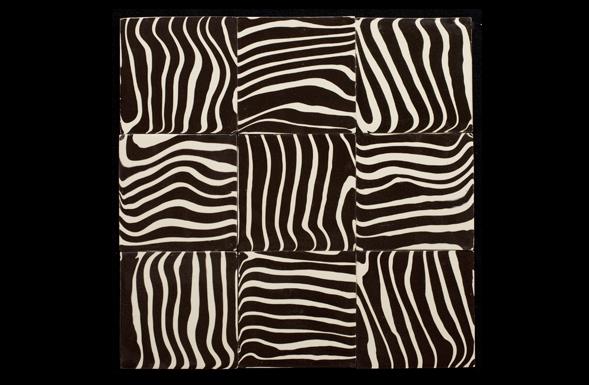
Across multiple tiles, the bistre striped Delft tile can create a flowing field of dark colour and pale linear movement. It may cover a complete wall or be used more selectively for skirting-level details, fireplace panels, splashbacks or framed decorative areas.
Related Striped and Waved Surfaces
Within the same Delft category, Ezel Burnt Umbra offers the related design in a burnt umber colourway. Ezel Green provides another interpretation of the same historic striped tile language.
Elsewhere in De Ferranti’s collections, Volcanicus Waves develops interlocking wave forms in black and terracotta volcanic stone. Z Stripe – Cream & Black on Wax explores a related two-colour linear rhythm through a repeating zigzag design.
Specification and Layout
When specifying the bistre striped Delft tile, the current format, colour variation and relationship between adjoining lines should be confirmed. Samples should be reviewed together so that the distribution of darker fields and lighter stripes can be planned before installation.
The intended substrate, grout, installation products, cleaning requirements and suitability for the proposed interior wall application should be confirmed before ordering.
Project Guidance and Enquiries
For project guidance, availability, pricing, samples or further information, please use the Send E-Mail button below this description. Your enquiry will come directly to De Ferranti, and we will be pleased to discuss suitability, quantities, lead times and options for your project.
Product Applications
Get a call back
DE FERRANTI
South Park Studios - Suite 10
88 Peterborough Road, London SW6 3HH
United Kingdom